
Jurats & the Oath
~11 min read · Administer the jurat correctly: signed in your presence plus a real oath, no exceptions.
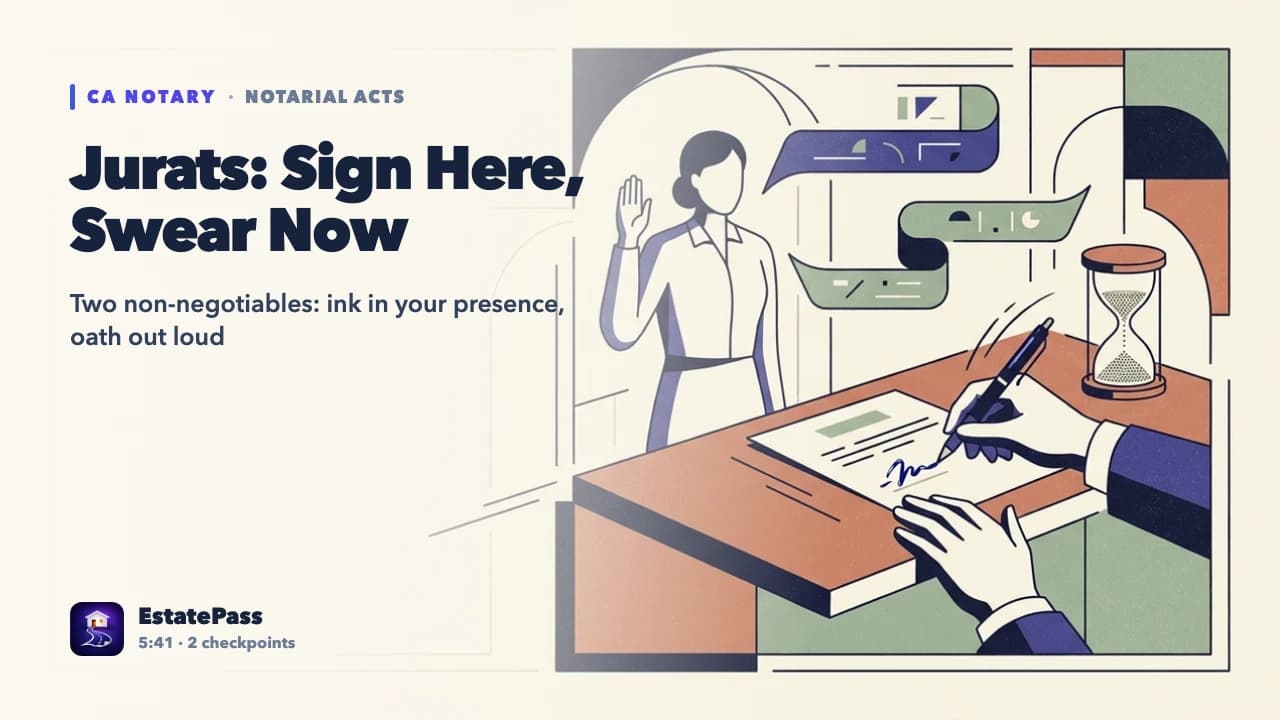
The jurat is the acknowledgment's stricter sibling: the signer must sign in front of you AND swear the contents are true. Skip the oath — the most commonly skipped step in real practice — and you have committed a penalty-carrying violation, not a technicality.
The two non-negotiables
A jurat (CC 1189's counterpart at CC 8202) requires that the signer sign the document in the notary's presence and then take an oath or affirmation that the contents are true. Both elements are mandatory every time: a pre-signed affidavit cannot receive a jurat (the signer must re-sign before you), and an unadministered oath is a $750-family violation. Identity must be established by satisfactory evidence, same as an acknowledgment.
- Sign IN THE NOTARY'S PRESENCE — no exceptions
- Administer a real oath or affirmation, aloud, every time
- Satisfactory-evidence identification applies to jurats too
The jurat certificate
The California jurat carries its own mandatory boxed notice (identical consumer language) and the operative line: 'Subscribed and sworn to (or affirmed) before me on this ___ day of ___, 20__, by ___, proved to me on the basis of satisfactory evidence to be the person(s) who appeared before me.' 'Subscribed' = signed before me; 'sworn' = oath administered. Venue, signature, and seal complete it. If the document's preprinted jurat lacks the notice or the satisfactory-evidence clause, attach the compliant California form.
- 'Subscribed and sworn to before me' is the signature phrase
- Boxed notice required, same as acknowledgments
- Non-compliant preprinted jurats → attach the CA form
Choosing between jurat and acknowledgment
The document's preparer or recipient chooses the act — the notary never selects for the signer (that would be UPL). Affidavits and declarations under oath take jurats; deeds and contracts take acknowledgments. When a signer asks 'which one do I need?', the script is: 'the agency or preparer that will receive this must tell you.' If the document has no certificate at all, the signer directs which form to attach.
Worked example
A process server arrives with a proof-of-service affidavit he signed at the office an hour ago and asks you to 'stamp the jurat.' He is in a hurry and waves off 'the swearing part' as a formality between professionals. Walk the correct handling.
Two defects to cure. The existing signature is worthless for a jurat — he must sign again, now, in your presence (line through or leave the old signature per the receiving court's preference; the operative signature is the one you witness). Then the oath, aloud and unambiguous: 'Do you swear or affirm that the contents of this document are true?' — his audible assent is the act; skipping it is a real violation with a real penalty, not professional courtesy. Then identification by satisfactory evidence, the compliant jurat certificate with venue and date, seal, and the journal entry. If he refuses the oath, you refuse the jurat.
Common exam pitfalls
Accepting a pre-signed document for a jurat.
Jurats require subscription in your presence — the signer signs again in front of you.
Treating the oath as implied by the paperwork.
The oath is a spoken ceremony with an audible response. No ceremony, no jurat — and a civil penalty for the skip.
Recommending a jurat because the acknowledgment 'seems weaker.'
Act selection belongs to the document's preparer/recipient. Choosing for the signer is unauthorized practice of law.
Jurat = Just Under my eyes, Right now, And sworn True.
Recap
- Jurat: sign in the notary's presence + oath/affirmation, both mandatory
- Satisfactory-evidence ID required
- 'Subscribed and sworn to before me' + boxed notice on the certificate
- Pre-signed documents must be re-signed before you
- Skipping the oath is a penalty violation
- The receiving party — never the notary — picks jurat vs acknowledgment
VIDEO LESSON
Watch this lesson on video — free
Prove it: 10 questions on this topic
Every lesson ends with a ten-question check in the free course — your progress syncs between the web and the EstatePass app.