
The One Active Journal
~11 min read · Keep sequential, complete journal entries — date, act, document, ID, fee, signature.
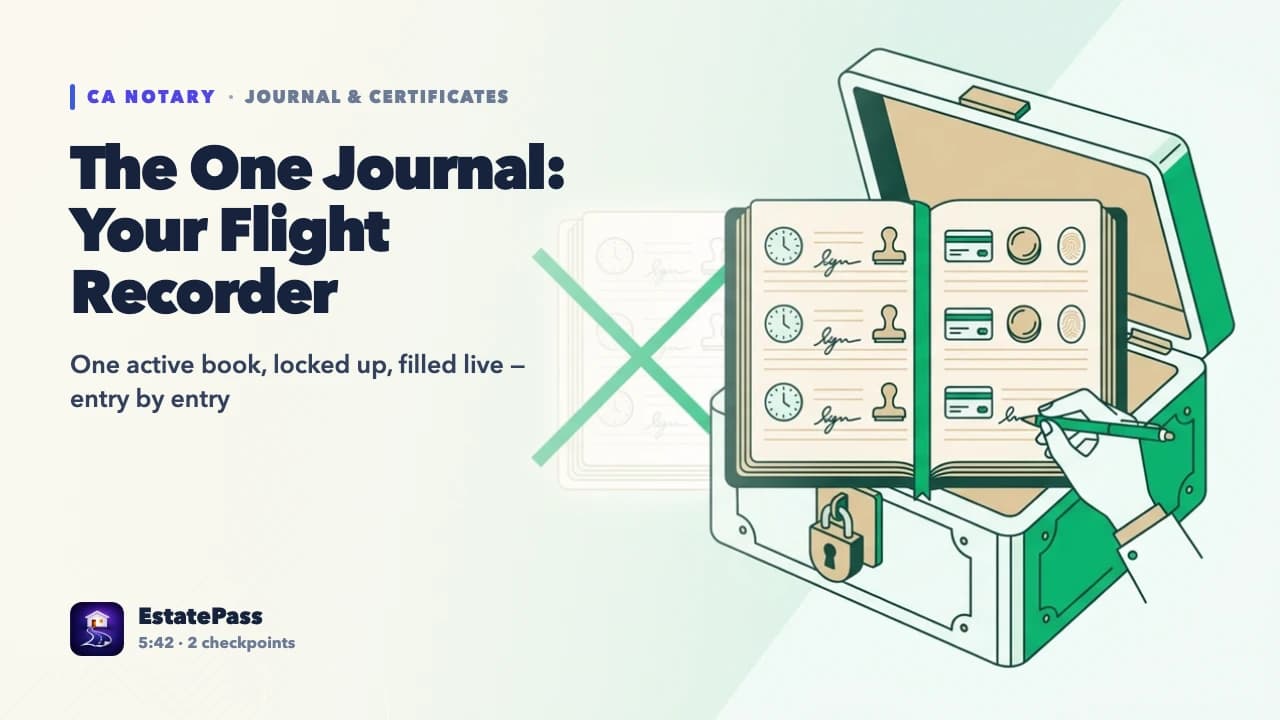
The journal is the notary's flight recorder: one active book, sequential entries, locked under your exclusive control. The exam tests the required contents of every line and the one-journal rule that catches notaries who keep a 'work book' and a 'mobile book.'
One journal, exclusively yours
A California notary keeps exactly one active sequential journal at a time. It must be kept in a locked and secured area under the notary's direct and exclusive control — an employer may not hold it, access it, or keep it when the notary leaves (the journal belongs to the notary even if the employer paid for it and for the commission). Wilful failure to secure the journal sits in the $1,500 penalty family.
- ONE active journal — never parallel books
- Locked, secured, exclusive control
- The employer owns neither the journal nor the commission
Required contents of every entry
Each entry records: date and time of the act; the type of act (acknowledgment, jurat, proof, oath); the character of the instrument (deed of trust, POA, affidavit…); the signature of each signer (and of credible witnesses, who also sign); the satisfactory-evidence basis — the ID type, issuing government, serial number, and issue/expiration dates, or the credible-witness details; the fee charged (entering '0' or 'no fee' when none); and the thumbprint when the document class requires it.
- Date/time, act type, document character
- Signer's signature in the journal itself
- ID particulars: type, government, number, dates
- Fee column always completed — zero is an entry, not a blank
Sequential and contemporaneous
Entries are made at the time of the act, in sequence, no blank lines held for later, no batch reconstruction at day's end. The journal is what converts a disputed certificate into defensible evidence years later — a court weighs a contemporaneous entry with a thumbprint far more heavily than any memory. Incomplete journals are the most common audit finding and the cheapest violation to avoid.
Worked example
A signing agent notarizes a deed of trust and a compliance affidavit for one borrower in one appointment, charging for two acts. Reconstruct what the journal must show before the borrower leaves.
Two acts, two entries, made now. Entry one — deed of trust: date/time, 'acknowledgment,' 'deed of trust,' borrower's journal signature, ID particulars (CA DL, number, issued/expires), the fee, and the thumbprint (deed of trust is on the thumbprint list). Entry two — affidavit: date/time, 'jurat' with the oath administered, 'compliance affidavit,' signature again, same ID particulars recorded for the entry, fee entered; no thumbprint required for the affidavit. Sequential lines, no gaps, completed before the borrower walks. Anything less — reconstructed at home, missing print, blank fee — is the audit finding pattern.
Common exam pitfalls
Keeping separate journals for office and mobile work.
One active journal, full stop. Parallel books are a violation, not an organization system.
Letting the employer store the journal.
Direct and exclusive control belongs to the notary — the journal leaves when you leave.
Leaving the fee column blank on free acts.
Enter '0' or 'no fee.' A blank is an incomplete entry.
One book, locked up, filled live: when-what-which-who-how-identified-how-much — plus the print when land moves.
Recap
- One active sequential journal, locked, exclusive control
- Employers have no right to hold or access it
- Every entry: date/time, act, instrument, signer's signature, ID details, fee
- Credible witnesses sign the journal too
- Fee column completed even at zero
- Entries contemporaneous and sequential — no blanks, no reconstruction
VIDEO LESSON
Watch this lesson on video — free
Prove it: 10 questions on this topic
Every lesson ends with a ten-question check in the free course — your progress syncs between the web and the EstatePass app.