
A broker who fails to promptly disclose their dual agency status is subject to:
Question & Answer
Review the question and all answer choices
a $10,000 penalty.
While financial penalties can be part of DRE disciplinary proceedings, a specific flat $10,000 penalty is not the standard consequence prescribed by California law for failure to disclose dual agency; the actual consequences are broader disciplinary actions determined by the DRE based on the severity of the violation.
liability for their clients’ money losses.
Although a broker who fails to disclose dual agency may ultimately face civil liability for client financial losses in a private lawsuit, the question asks about the regulatory consequence of non-disclosure, which is disciplinary action — not a direct liability rule triggered automatically by the failure to disclose.
disciplinary action by the Internal Revenue Service (IRS).
frequent auditing by the Federal Bureau of Investigation (FBI).
The Federal Bureau of Investigation has no jurisdiction over real estate license law violations or agency disclosure failures; the FBI investigates federal crimes such as wire fraud or mortgage fraud, not state-level brokerage relationship disclosure requirements.
Why is this correct?
Under California Business and Professions Code § 10176 and the agency disclosure requirements of Civil Code § 2079.13–2079.24, a broker who fails to promptly disclose dual agency status is subject to disciplinary action by the California Department of Real Estate, which can include license suspension, revocation, fines, and required education. The DRE — not the IRS or FBI — is the state regulatory body with jurisdiction over broker conduct and license law violations. This disciplinary authority is the primary enforcement mechanism for agency disclosure failures in California.
Continue Learning
Explore this topic in different formats
More laws-of-agency-fiduciary-duties Videos
Continue learning with related video lessons
Before soliciting business for a brokerage office operating under a fictitious business name, the broker is not required to:
2:55 • 0 views
A disclosure which warns a buyer they may be liable for additional tax obligations after the close of escrow is the:
2:47 • 0 views
The seller states they will accept the buyer’s offer if the broker lowers their 6% commission by 25%. If the broker accepts, they will receive:
3:05 • 0 views
For a buyer’s broker to have the ability to negotiate their fee, the buyer’s broker needs to enter into an employment agreement with their buyer, called a(n):
2:38 • 0 views
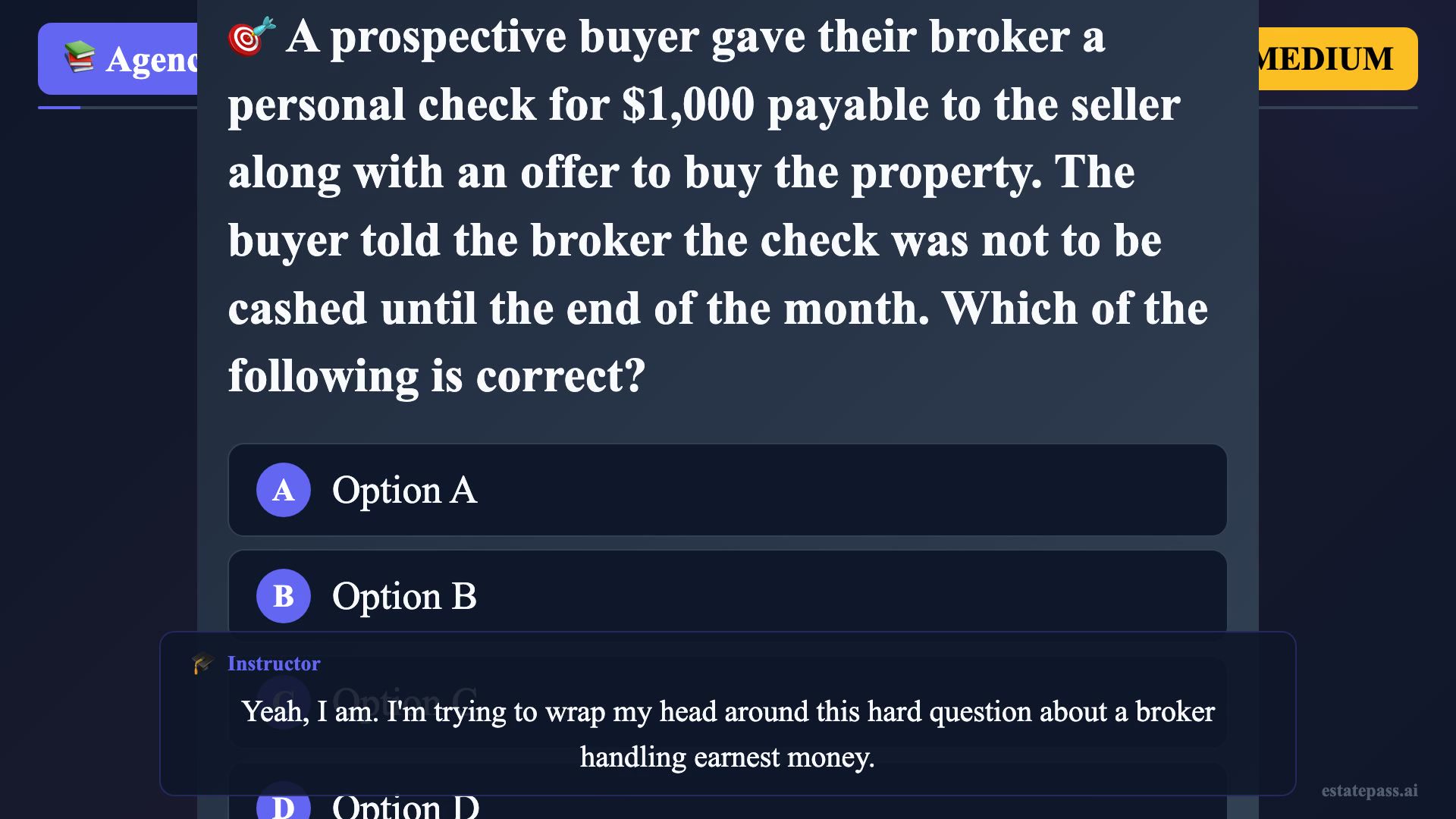
A prospective buyer gave their broker a personal check for $1,000 payable to the seller along with an offer to buy the property. The buyer told the broker the check was not to be cashed until the end of the month. Which of the following is correct?
2:39 • 0 views
Ready to Ace Your Real Estate Exam?
Access 2,000+ free video lessons covering all 11 exam topics.