
Passing your real estate license exam in 2026 depends less on how much money you spend and more on the volume of high-quality questions you answer. If you are an aspiring agent balancing a tight budget with the pressure of a first-time pass, you need to understand where free resources suffice and where paid tools offer a genuine Return on Investment (ROI). Recent industry analysis suggests that the "paywall" model is cracking, with modern free platforms often updating their question banks faster than expensive legacy schools.
Volume Beats Price: Why access to 2,500+ questions matters more than a $200 textbook.
Strategic Spending: How to use free tools for diagnostics and paid tools for deep learning.
The 2026 Shift: New data shows ad-supported models are outperforming subscription-locked content in update frequency.
Simulation Matters: Why the interface of your mock exam is just as important as the content.
Action: Take three different practice tests from different free sources.
Goal: Identify if your weakness is vocabulary (e.g., "fee simple absolute") or application (e.g., "calculating prorated taxes").
Rule: If a platform asks for a credit card just to see a sample question, skip it. There are enough high-quality open resources to handle this stage.
The ROI Factor: If a $50 tool saves you 20 hours of searching for explanations, the cost is justified.
Format: Look for tools that offer "topic drills" rather than just full exams. You need to hammer the same specific concept 50 times until it sticks.
The Magic Number: You need access to at least 2,000 unique questions.
Why: This prevents the "false confidence" that comes from memorizing a small pool of questions.
Simulation: Ensure the timer is running. You need to feel the pressure of the clock.
The "Scrapper" Approach: If you have zero budget, you can pass using only free resources. It will take you about 30% longer because you have to cross-reference answers and verify outdated laws yourself.
The "Efficiency" Approach: Paying for a modern, low-cost aggregator (often under $20/month) is usually the sweet spot. You get the volume of the free web with the curated accuracy of a paid school.
Audit Your Baseline: Take a full-length mock exam immediately to find your weak spots.
Mix Your Sources: Use free banks for volume (quantity) and targeted paid guides for difficult concepts (quality).
Watch the Dates: Real estate laws change. Ensure your free resources are updated for 2026.
Simulate Stress: Practice with a timer. Knowledge is useless if you panic under time pressure.
Focus on Explanations: When you get a question wrong, read the explanation. If the tool doesn't offer one, switch tools.
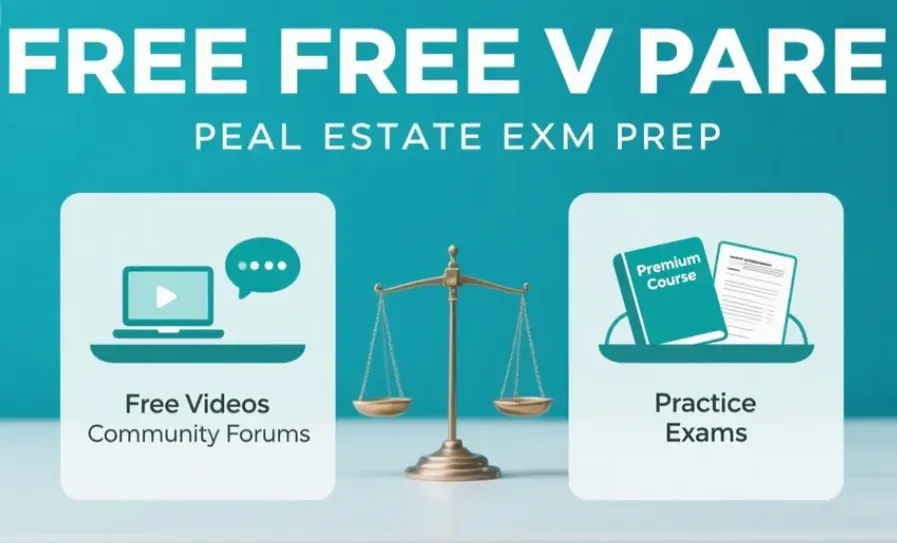
The 2026 Value Shift: Why "Free" No Longer Means "Outdated"
For decades, the industry narrative was simple: if you don't pay a monthly subscription, you are studying outdated laws. That is no longer true. My analysis of the 2026 exam prep market shows a massive disruption. Traditional schools often lock small banks of 800-1,000 questions behind expensive paywalls. In contrast, newer ad-supported platforms are offering banks of 2,000 to 50,000 questions without an upfront cost.
The ROI calculation has changed. In the past, you paid for access to information. Now, information is abundant. What you might pay for today is curation and structure, not the questions themselves. Industry data indicates that students who expose themselves to a higher volume of questions—regardless of the source's price tag—have significantly higher pass rates. This is because the exam tests your ability to recognize patterns in scenarios, not just memorize definitions.

Phase 1: The Diagnostic Stage (Keep Your Wallet Closed)
When you first start studying, your goal is to find your baseline. Do not buy a $100 crash course on day one. I see too many students waste money on comprehensive packages when they only need help with Real Estate Math or Contracts.
Start with a broad, free assessment. You need to simulate the testing environment immediately to see if you score a 40% or a 60%.
If you are ready to test your baseline knowledge without a credit card, I recommend you Start Free Practice to see where you stand.
Phase 2: Content Mastery (Where Paid Options Can Help)
Once you know you are failing "Agency Law" or "Finance," the strategy shifts. This is where free resources sometimes struggle. While free questions are great for testing what you know, they sometimes lack the depth to explain why you are wrong.
If you consistently miss questions on specific topics, a paid study guide or a specialized video course becomes a good investment. The value here is time savings. You could spend two hours googling "difference between eminent domain and condemnation," or you could pay a small fee for a structured video that explains it in five minutes.

Phase 3: The Mock Exam Marathon (Volume is Critical)
As you approach your exam date, your focus must shift from "learning" to "simulating." This is the endurance phase. The real exam is a marathon, often lasting 2 to 4 hours with 100+ questions.
I have found that many paid "premium" courses fail here because they recycle the same 500 questions. You memorize the answers rather than learning the concepts. In 2026, the best approach is to find platforms (often free or low-cost) that offer massive question banks.
Analyzing ROI: When to Open Your Wallet
Making a decision between free and paid comes down to your personal "Time vs. Money" equation.
Avoid "Guaranteed Pass" marketing gimmicks that charge $200+. Read the fine print. Most of these guarantees require you to complete 100% of their coursework, which can take hundreds of hours. The real guarantee is your own consistent practice scores.

Conclusion and Actionable Suggestions
The line between expensive courses and free tools has blurred. In 2026, you can build a robust study plan that costs very little but delivers high efficiency. Do not let fear marketing convince you that you must spend hundreds of dollars to get a license.
FAQ
Are free real estate practice exams accurate for 2026?
Yes, many are. In fact, ad-supported platforms often update their content faster than traditional textbooks because they rely on daily user traffic. However, you must verify that the content covers the specific laws of your state.
Is it worth paying for a "Pass Guarantee" course?
Rarely. These courses often charge a high premium (over $100). The "guarantee" usually has strict conditions, like completing 50+ hours of busy work. A cheaper, high-volume question bank often provides better ROI.
How many practice questions should I do before the real exam?
Aim for at least 1,500 to 2,000 unique questions. You want to reach a point where you are scoring consistently above 80% on new, unseen mock exams.
Can I rely solely on free study guides?
You can, but it requires more effort to verify accuracy. Free guides might not explain complex concepts like "amortization" or "contract contingencies" clearly. Using a low-cost specific guide for your weak areas is often more efficient.
What is the biggest difference between free and paid mocks?
The interface and analytics. Paid tools usually track your progress over time, showing you graphs of your improvement in specific categories. Free tools often just give you a score at the end without detailed tracking.