
Passing the real estate exam on your third attempt requires treating your previous results as valuable data points rather than personal failures. If you are a retaker feeling stuck between "knowing the material" and failing the test, you need to shift from passive reviewing to aggressive remediation. This guide moves beyond generic advice to help you execute weak topic diagnosis, fix timing issues, and rebuild confidence through targeted drills and precise mock exams.
Diagnosing specific knowledge gaps using your previous exam score reports.
Replacing passive reading with active recall strategies like flashcards and teaching concepts.
Mastering exam pacing to eliminate anxiety and ensure you finish every section.
Structuring a remediation plan that prioritizes accuracy in high-value categories.
Real Estate Math: often neglected due to fear or lack of practice.
Contracts and Agency: these sections usually carry the highest weight on the exam.
State-Specific Laws: regulations vary significantly and require precise memorization.
Flashcards: Use them for vocabulary terms like "lis pendens" or "encroachment."
The Feynman Technique: Try to teach a complex concept (like amortization) to an imaginary student.
Blank Sheet Method: Write a topic at the top of a page and fill it with every fact you know from memory.
Builds Stamina: The exam is long; your brain needs to be trained to focus for 3-4 hours.
Reduces Panic: Familiarity with the ticking clock makes it less intimidating.
Identifies Slow Spots: You will see exactly which types of questions slow you down.
Data over Emotion: View a wrong answer as data to fix, not a personal flaw.
Process over Outcome: Focus on hitting your daily study goals, and the result will take care of itself.
Rest is Productive: A tired brain makes mistakes. Ensure you sleep well during your intensive study weeks.
Analyze your diagnostic report immediately to find the 2-3 topics that caused you to fail.
Commit to active recall by using flashcards and teaching the material aloud instead of passively reading.
Implement the "Three-Pass Strategy" during mock exams to fix timing issues and reduce anxiety.
Target an 85% score on practice tests to ensure a buffer for test-day nerves.
Schedule your exam for 3 weeks out to create a focused, high-intensity remediation window.
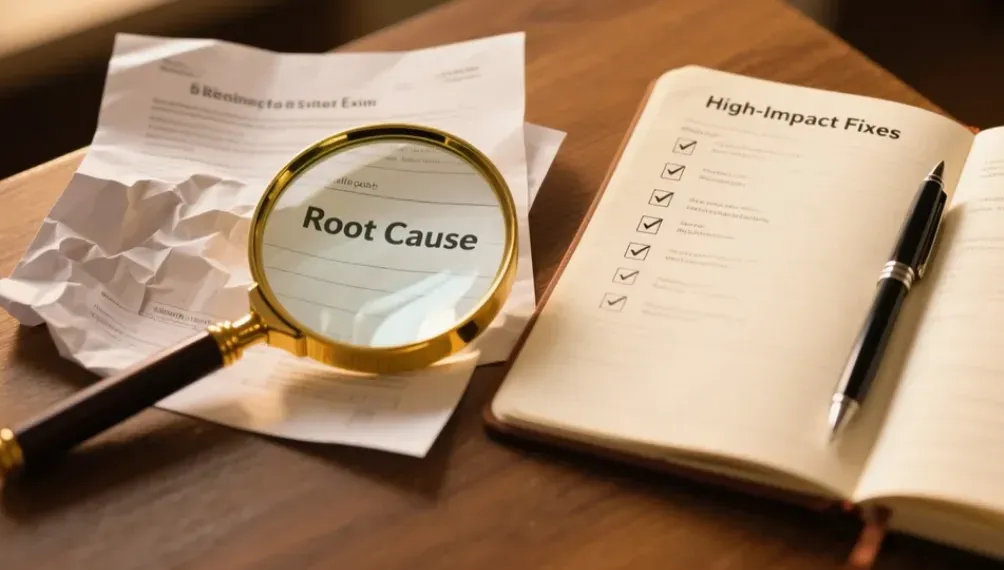
Diagnose Before You Reload: The Autopsy of a Failed Exam
The biggest mistake I see retakers make is immediately diving back into their textbooks from page one. This is a waste of time because you likely already know 60-70% of the material. The reason you failed twice is hidden in the 30-40% you don't know, and your previous exam results hold the key. Most state testing centers provide a diagnostic report or a "score sheet" that breaks down performance by category, such as Contracts, Financing, or Agency.
You must analyze this report to identify your "root cause" categories. If you scored 85% in Property Ownership but only 40% in Real Estate Math, spending hours rereading property laws is inefficient. I recommend creating a "triage list" where you rank topics from weakest to strongest. Focus 80% of your study time solely on the bottom three categories.
Common Weak Areas for Retakers:
According to state licensing data, candidates who analyze their diagnostic reports and focus on specific weak areas see a significantly higher pass rate on subsequent attempts. You cannot fix what you do not measure.
Actionable Suggestion: Locate your score reports from your last two attempts. Identify the two sections with the lowest percentages and commit to doing 50 targeted practice questions per day on only those topics for the next week.
Abandon Passive Review for Active Remediation
I cannot stress this enough: reading your textbook is not studying. Passive reading creates a "fluency illusion" where you recognize the text and think you understand it, but you cannot recall the information under exam pressure. For a remediation plan to work in 2026, you must switch to active recall methods. This means forcing your brain to retrieve information without looking at the answer first.
Active remediation involves testing yourself constantly. Instead of reading a chapter summary, close the book and try to write down everything you remember about "Fee Simple Defeasible." If you can't explain it simply, you don't know it. This method exposes gaps in your understanding immediately, allowing you to fix them before test day.
Effective Active Recall Methods:
Industry analysis indicates that students who utilize practice exams and active question banks have a much higher success rate than those who rely solely on course lectures. The act of answering questions strengthens the neural pathways needed during the actual exam.
Actionable Suggestion: Stop highlighting your book. Instead, create a set of physical or digital flashcards for every term you missed in your diagnostic review and drill them until you get them right three times in a row.
Mastering the Clock: Solving Timing Issues and Anxiety
Many candidates fail not because they lack knowledge, but because they lack a strategy for the clock. Timing issues often lead to panic, causing you to rush through the final questions or leave them blank. If you found yourself racing against the timer in your previous attempts, your remediation must include simulated timing drills. Anxiety narrows your focus and reduces your ability to think critically, so getting comfortable with the pressure is non-negotiable.
I recommend using a "Three-Pass Strategy" to manage your time effectively. On your first pass through the exam, answer only the questions you know instantly. Bookmark anything that requires calculation or deep thought. On the second pass, tackle the bookmarked questions. On the final pass, make educated guesses on the remaining difficult items. This ensures you bank all the easy points before getting bogged down by the hard ones.
Benefits of Timed Simulations:
Expert tutors suggest that taking full-length, timed mock exams is the closest you can get to the real experience. This "stress inoculation" helps you remain calm when you face difficult questions on the actual test day.
Actionable Suggestion: Schedule at least two full-length mock exams this week. Take them at the same time of day as your scheduled real exam, with no phone and no notes, to fully simulate the testing environment.
Constructing a Data-Driven Retake Schedule
Your study schedule for the third attempt must be radically different from the first two. It needs to be shorter, more intense, and data-driven. A long, drawn-out study period often leads to burnout and forgetting earlier material. I suggest a compressed timeline of 2-3 weeks of high-intensity review rather than months of casual study. This keeps the information fresh and your motivation high.
In this phase, you should rely heavily on high-quality mock exams that mimic the 2026 test format. The goal is to see a consistent score of 80% or higher on these practice tests before you walk into the exam center. If you are consistently scoring 65% or 70% at home, you are not ready. You need tools that provide immediate feedback and explanations for every wrong answer.
For a structured approach to this final push, you might consider resources that specialize in remediation. A solid Retake Plan + Mock Exams can provide the focused question banks and simulated environments necessary to bridge the gap between failure and licensure. These tools often use adaptive technology to serve you more questions in your weak areas automatically.
Actionable Suggestion: Block out 2 hours every evening for the next 14 days. Dedicate the first hour to taking a practice test and the second hour to reviewing every explanation for the questions you got wrong.
Rebuilding Confidence Through Competence
Failing twice takes a toll on your mindset. You might start doubting your intelligence or your ability to become an agent. I want you to know that this exam tests your ability to take a test, not your potential as a realtor. Confidence doesn't come from affirmations; it comes from competence. When you see your practice scores rising from 60% to 85%, your anxiety will naturally decrease.
Visualizing success is helpful, but "doing the reps" is what builds mental toughness. Treat your preparation like an athlete training for a game. Every correct answer on a practice drill is a small victory that rebuilds your self-belief. When you sit down for the third time, you won't be hoping to pass; you will expect to pass because you have seen the evidence of your readiness in your practice scores.
Mindset Shifts for the Third Attempt:
Actionable Suggestion: Keep a "Success Log" where you record your daily practice scores. Seeing the numbers trend upward over two weeks provides tangible proof that you are improving.
FAQ
How long should I wait before retaking the exam for the third time?
I recommend waiting only as long as it takes to complete a 2-3 week intensive remediation plan. If you wait too long (months), you risk forgetting the material you already know. Check your state's specific rules regarding waiting periods between attempts.
Is it worth taking a crash course if I failed twice?
A weekend crash course can be helpful for a final review, but it is not a substitute for diagnosing your weak areas. If you don't address the specific topics you struggle with (like Math or Contracts), a general overview course might not fix the root problem. Targeted drills are usually more effective for retakers.
What if I keep running out of time on the math section?
Save the math questions for the end. Math questions often take the longest but are worth the same points as a quick vocabulary question. By skipping them initially, you ensure you answer all the theory questions first, then you can use your remaining time to calculate without panic.
How do I know if I am ready to retake the test?
You are ready when you can consistently score 80-85% on new, unseen practice exams. If you are memorizing answers to old questions, that doesn't count. You need to be passing fresh mock exams with a comfortable margin to account for test-day stress.
Conclusion and Actionable Suggestions
Passing the real estate exam after two failures is entirely possible, but it requires a change in strategy. You must stop "studying" in the traditional sense and start training specifically for the test. By diagnosing your weak points, managing your time, and using active recall, you can turn your third attempt into your final one.