
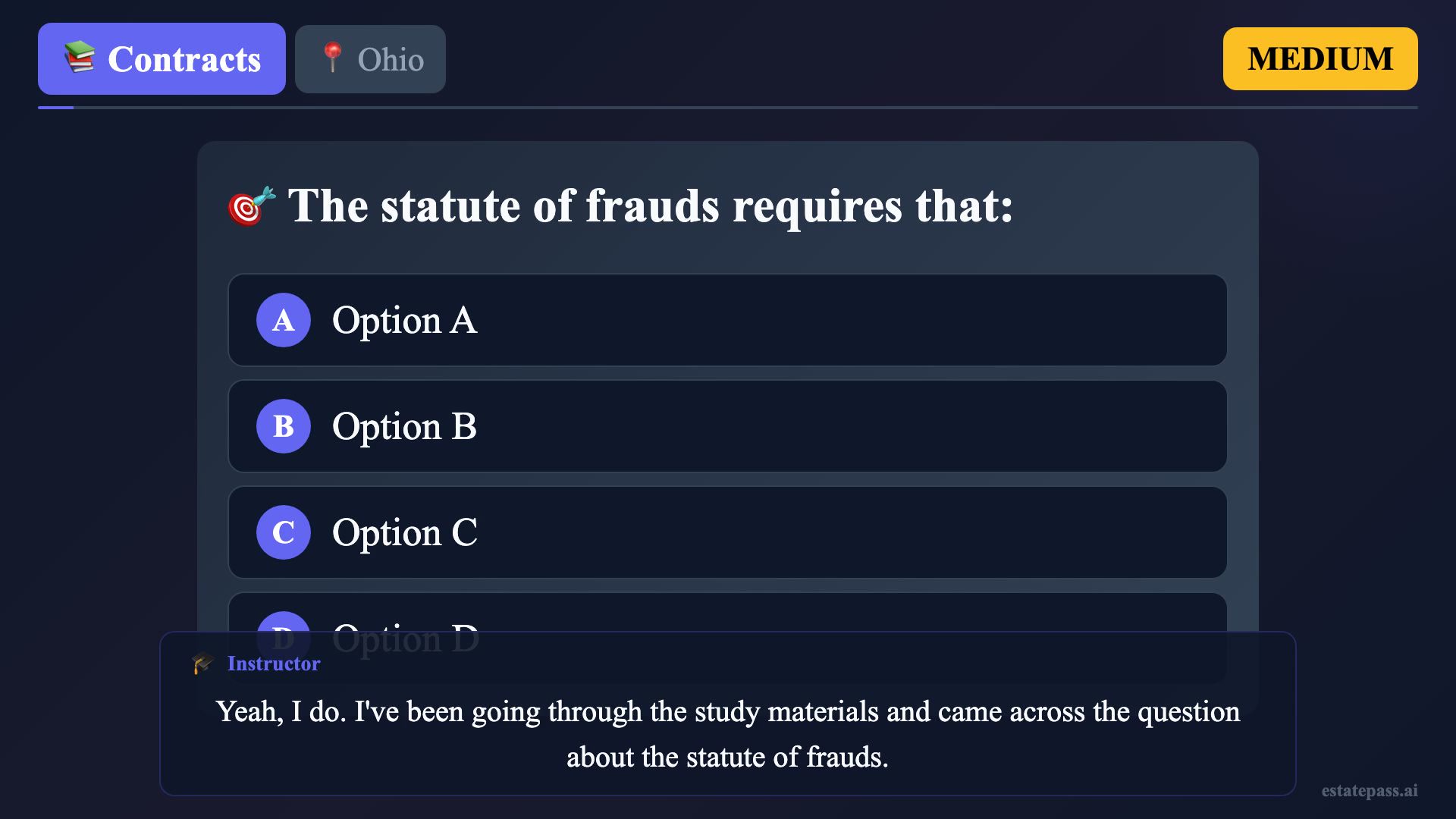
Under Ohio law, the Statute of Frauds requires:
Question & Answer
Review the question and all answer choices
Verbal agreements to be witnessed
Ohio's Statute of Frauds does not require verbal agreements to be witnessed. The statute specifically addresses contracts that must be in writing to be enforceable, not the witnessing of verbal agreements. Verbal agreements for real estate transactions are generally unenforceable under the Statute of Frauds regardless of whether they are witnessed or not.
Real estate contracts to be in writing and signed
All contracts to be notarized
The Statute of Frauds does not require contracts to be notarized. While notarization may be required for certain documents like deeds, it's not a requirement for the basic enforceability of real estate contracts under this statute.
Court approval for all sales
Court approval is not required for standard real estate sales under the Statute of Frauds. This requirement applies only in specific situations like partition actions or certain foreclosure proceedings, not for typical real estate transactions.
Why is this correct?
Under Ohio law, the Statute of Frauds specifically requires real estate contracts to be in writing and signed by the party to be charged. This ensures enforceability and prevents disputes over oral agreements involving such significant transactions.
Continue Learning
Explore this topic in different formats
More Contracts Videos
Continue learning with related video lessons

Ready to Ace Your Real Estate Exam?
Access 2,000+ free video lessons covering all 11 exam topics.