
You can pass the real estate licensing exam on your first try by focusing strictly on the specific terminology that appears on the test rather than trying to perfect your general English fluency. If you are an ESL learner preparing for the 2026 exam cycle, your biggest obstacle is likely not the real estate concepts themselves, but the confusing "legalese" used in question phrasing. I have analyzed countless exam failures, and they often stem from a simple misunderstanding of key terms or sentence structures rather than a lack of industry knowledge.
Prioritize High-Value Vocabulary: Focus on words that have different meanings in real estate than in daily life.
Simplify Sentence Structures: Learn to strip away complex phrasing to find the core question.
Strategic Mock Testing: Use practice exams to identify linguistic traps, not just knowledge gaps.
Visual Learning: Connect abstract legal concepts to physical scenarios to bypass translation hurdles.
Real Estate vs. Real Property: Real estate is just the land and structures; real property includes the "bundle of rights" (legal ownership benefits).
Client vs. Customer: A client has a contract with you (agency relationship); a customer is just someone you help without a contract.
Grantor vs. Grantee: The grantor gives the deed (seller); the grantee receives the deed (buyer).
Functional Obsolescence: A loss in value because the building is outdated (e.g., a 5-bedroom house with only 1 bathroom).
Dual Agent: An agent representing both the buyer and seller in the same transaction (requires careful legal disclosure).
Amortization: The process of paying off a debt with regular payments over time.
Encumbrance: Any claim or liability attached to a property, like a lien or mortgage, that limits the owner's rights.
"Time is of the essence": This means deadlines are strict and automatic breach of contract occurs if missed.
"Subject to": The buyer takes over payments but the seller stays liable for the loan.
"Arm's length transaction": A fair deal between strangers, not influenced by family ties.
Week 1: Vocabulary drilling. Focus on the Glossary and "False Friends."
Week 2: Principles and Law. Focus on Agency and Contracts.
Week 3: Math and Finance. Learn the formulas for Cap Rate and Commission. Math is a universal language and a great way to score easy points.
Week 4: Mock Exams. Take one full exam every day. Review every wrong answer to understand why you misunderstood the English.
Visual Charts: Flowcharts for the closing process or eviction timeline.
Audio Options: Being able to listen helps with pronunciation and memory.
Interactive Quizzes: Immediate feedback helps you correct misunderstandings instantly.
Build Your Glossary: Create a personal dictionary of the top 100 most difficult terms and review it daily.
Focus on Roots: Learn prefixes and suffixes (like -or vs. -ee) to decode new words on the fly.
Simulate Exam Conditions: Take practice tests with a timer to get used to the pressure of reading quickly.
Visualize Concepts: Draw pictures for terms like "easement" or "encroachment" to lock them in your memory without relying on words.
Master the Math: Secure easy points by memorizing all financial formulas perfectly.
Decoding the "Language of Real Estate" vs. Everyday English
The real estate exam is essentially a language test disguised as a professional assessment. I often see students struggle because they translate words literally, but the exam uses a specific dialect I call "Real Estate Legalese." For instance, in normal conversation, "fixture" might mean a sporting event or a permanent problem, but in our context, it specifically refers to personal property that has become real property. Understanding this distinction is vital because the exam loves to trick you with these double meanings.
Another major pain point is the suffix trap. According to educational experts, the confusion between "-or" (giver) and "-ee" (receiver) causes a significant number of errors on finance questions. You might know what a mortgage is, but if you mix up "mortgagor" (the borrower) and "mortgagee" (the lender), you will get the answer wrong every time. The exam writers know this is a weak spot for non-native speakers and intentionally phrase questions to exploit it.
Confusing Pairs You Must Master:
Actionable Suggestion: Create a "False Friends" list. Write down every word that has a different meaning in your native language or daily English compared to real estate definitions. Review this list every morning.

Essential 2026 Vocabulary List for Non-Native Speakers
For the 2026 exam cycle, the focus is shifting heavily toward agency relationships and property conditions. You cannot afford to be vague about these terms. Industry analysis indicates that recent exams are testing "Material Fact" and "Functional Obsolescence" with increasing frequency. A "Material Fact" isn't just any detail; it is a specific piece of information that would change a buyer's decision, like a leaking roof or a nearby highway. If you miss this nuance, you will fail the ethics section.
I also recommend spending extra time on the "Bundle of Rights." This concept is abstract and difficult to translate. It breaks down ownership into specific privileges: the right of possession, control, exclusion, enjoyment, and disposition. Exam questions often describe a scenario where one of these rights is restricted (like an easement) and ask you to identify which stick in the bundle is affected.
Top Priority Terms for ESL Students:
Actionable Suggestion: Do not use a standard dictionary. Use a specialized real estate glossary and rewrite the definitions in your own "Plain English" words. If you can explain "amortization" to a 10-year-old, you are ready.

Deconstructing Complex Question Patterns
Reading comprehension is often the silent killer for ESL students. Exam questions are notoriously wordy, using double negatives or terms like "EXCEPT," "NOT," and "MOST LIKELY." I tell my students that half the battle is just figuring out what is being asked. A question might read, "Which of the following is NOT an example of a non-freehold estate?" This is a mental pretzel. You need to simplify it: "Find the freehold estate."
Market data from exam prep providers suggests that successful candidates spend more time analyzing the question stem than the answer choices. When you see a long scenario, look for the subject and the verb immediately. Ignore the fluff. If the question describes a "lovely Victorian home with a river view," that is usually distraction. The core issue is likely about the zoning or the deed.
Common Tricky Phrasing:
Actionable Suggestion: Practice the "Slash and Burn" technique. Print out practice questions and physically cross out adjectives and background story that do not impact the legal situation. Isolate the legal question.

A Strategic 30-Day "Immersion" Study Plan
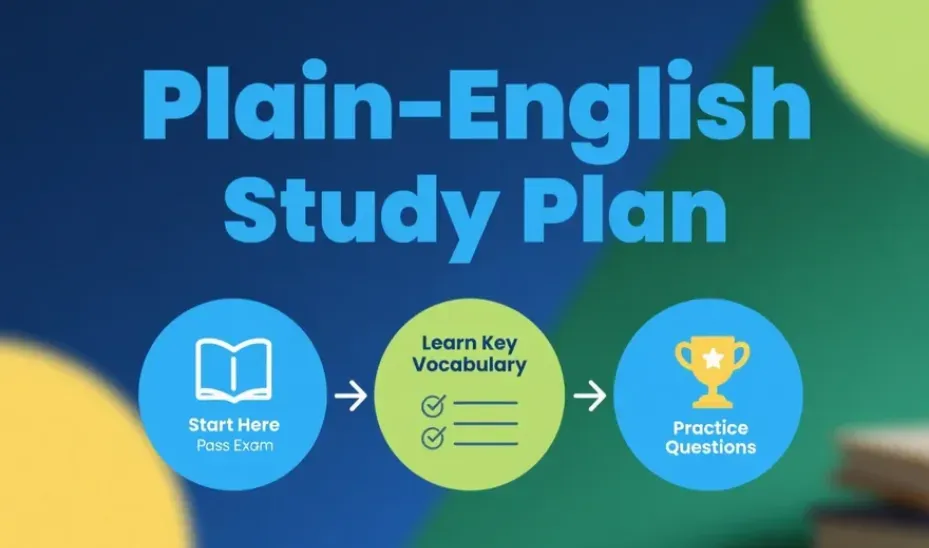
You do not need months of aimless reading; you need 30 days of intense, targeted practice. The most effective approach for ESL learners is immersion. This means surrounding yourself with the vocabulary so it becomes second nature. I recommend a split schedule: spend the morning on vocabulary acquisition and the evening on application through practice questions.
Many students make the mistake of studying broadly. Instead, you should aim for a 90% pass rate on mock exams before scheduling the real test. Educational platforms emphasize that consistently scoring high on practice tests is the only reliable predictor of success. If you are scoring 70% at home, the stress of the real exam environment will likely drop your score below the passing threshold.
Weekly Breakdown:
Actionable Suggestion: Record yourself reading your vocabulary list and definitions aloud. Listen to it during your commute or chores. Hearing the words reinforces retention better than just reading.
Leveraging Modern Tools for Comprehension
Traditional textbooks are often written in dry, academic English that is impenetrable for non-native speakers. They explain complex terms using other complex terms. I believe the best way to study today is by using resources that prioritize "Plain English" explanations. You need study guides that break down high-level concepts into simple, digestible logical flows without the fluff.
This is where finding the right summary materials becomes vital. You want resources that strip away the legal jargon and explain the concept first. For example, Topic Study Guides are excellent for this because they often present information in structured, bite-sized formats that are easier to digest than a 500-page textbook. These types of modern guides focus on the core logic of real estate—Cause, Effect, and Solution—which transcends language barriers.
What to Look for in Study Aids:
Actionable Suggestion: When you encounter a difficult topic like "Title Theory vs. Lien Theory," look for a diagram or a simple comparison table online. Visuals bypass the language processing center of the brain.

FAQ
Q: Can I use a dictionary during the real estate exam?
A: generally, no. Most states and testing centers (like PSI) do not allow personal items, including dictionaries, into the exam room. You must rely on your internal vocabulary bank.
Q: Is the math section harder for ESL students?
A: Actually, I find that ESL students often perform better on the math section. The numbers are universal, and the questions are usually shorter and more direct. Master the formulas to boost your overall score.
Q: How do I handle words I've never seen before on the exam?
A: Use context clues. Look at the other words in the sentence. Also, analyze the root of the word (e.g., "beneficiary" comes from "benefit"). If you are stuck, eliminate the answers you know are wrong and guess.
Q: Should I take the exam in Spanish (or my native language) if available?
A: Be careful. While some states offer translated exams, the translations can sometimes be awkward or imprecise. If you studied in English, switching languages for the test might actually confuse you. Stick to the language you studied in.
Conclusion and Actionable Suggestions
Passing the real estate exam as an ESL student is absolutely achievable if you treat it as a vocabulary challenge first and a knowledge test second. You have the intelligence to be a great agent; you just need to crack the code of the exam questions. Do not let the fancy words intimidate you.