
I almost lost a $380K listing in Arcadia because I miscounted the seller's disclosure deadline by one day. The buyer's agent was already drafting the cancellation notice when I caught it at 4:47 PM on a Friday. That was 2019, and I've never let a deadline slip since.
Real estate contract deadlines are the specific timeframes within which parties must complete actions like inspections, loan approvals, or disclosures — and missing even one can cost you the deal or worse, a lawsuit. The problem isn't that agents don't know deadlines exist. It's that we're juggling twelve transactions at once, and our brains aren't built to track overlapping countdowns across different contract dates.
Most agents handle this with calendar reminders or (honestly) a growing sense of dread. Neither works reliably. Here's the system I built after that near-disaster, and it's held up through 200+ closings since.
Start With Acceptance Date, Not List Date
Every deadline clock starts ticking from contract acceptance, not when you went pending or when the buyer first saw the property. Sounds obvious, but I've watched agents count from the wrong date more times than I can count (including myself on that Arcadia listing).
The moment all parties sign, I open a tracking sheet and write the acceptance date at the top. Then I map every single deadline forward from that anchor point. In Arizona, that typically means:
Inspection period: 10 days from acceptance
Loan approval contingency: 21 days from acceptance
Seller disclosures: 5 days from acceptance (or 3 days after receipt if buyer provides)
Appraisal contingency: typically tied to loan timeline
Final walkthrough: 5 days before close
Title work completed by March 8th (7 days before)
Final numbers to lender by March 10th (5 days before)
Buyer's final walkthrough scheduled by March 12th (3 days before)
All contingencies removed by February 22nd (21 days before)
When a buyer's lender "forgot" to order the appraisal until I called on day 18
When a seller's HOA took five days to produce documents I'd requested with a seven-day internal deadline
When a buyer ghosted their agent for 48 hours right before their inspection objection was due
The common mistake here is assuming "business days" when the contract says "calendar days" or vice versa. Arizona's residential purchase contract uses calendar days for most deadlines. Other states differ. Read your contract language every single time.
Build Backward From Close of Escrow
Most agents work forward from acceptance, which makes sense until you realize the closing date is the one immovable object in the timeline. I learned this from a transaction coordinator in Tempe who'd been doing this since 2008.
She taught me to mark the closing date first, then count backward to set internal deadlines that give me buffer room. If we're closing on March 15th, I need:
This backward-building creates cushion. When the appraiser runs late or the buyer's lender goes dark for three days, I've got room to absorb it without pushing close.
The thing that surprised me most about this approach was how much calmer my clients became. When you can tell them "we're still two days ahead of schedule" instead of "we're cutting it close," the anxiety drops noticeably.
Track Contingency Removals Separately From Deadlines
Here's what tripped me up for years: a contingency deadline passing doesn't automatically mean the contingency is removed. The buyer has to actively waive it in writing.
I had a deal in Gilbert where the inspection period expired, but the buyer never signed the contingency removal form. Technically, they could've still walked based on inspection issues because they hadn't waived that right. Their agent didn't realize it either until the title company caught it four days later.
Now I maintain two columns: "Deadline Date" and "Removal Confirmed." Every contingency gets both. And I don't just wait for the other side to send the removal form — I send a reminder email two days before each deadline expires.
What matters here is documentation. If a buyer misses their inspection objection deadline, you need proof they received notice of that deadline. Most purchase contracts require written notice of deadline expirations. I send mine via email with read receipts and follow up with text.
Set Internal Deadlines Three Days Earlier Than Contract Deadlines
Do you really want to be chasing a buyer's loan approval letter on the exact day it's due? I don't anymore.
Every external deadline in my system has an internal deadline that's three days earlier. If the contract says appraisal contingency expires on day 21, my calendar alarm goes off on day 18. This gives me time to nudge, follow up, or escalate before we're actually in breach.
The three-day buffer has saved me more times than I can count:
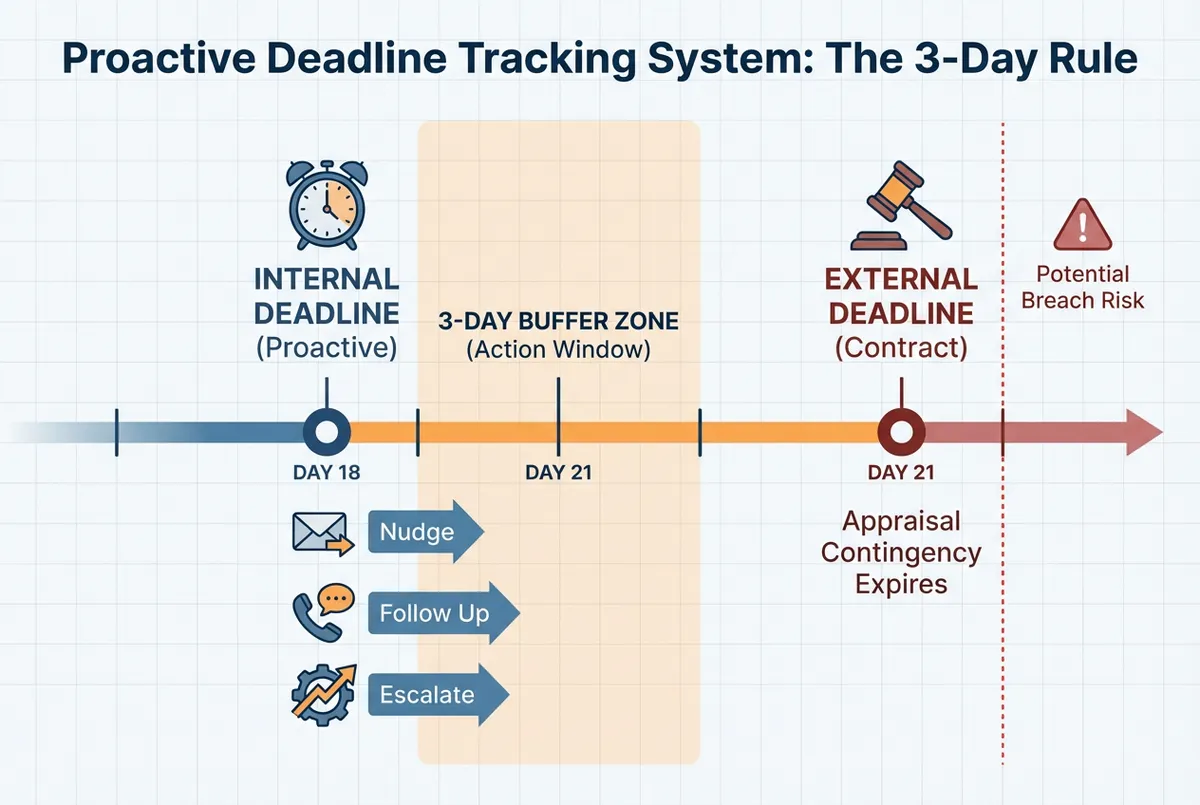
Common mistake: setting the internal deadline but not telling your client about it. I tell sellers, "The contract gives them until the 15th, but I'm tracking it for the 12th so we have time to respond." They appreciate the proactivity.
Use a Visual Timeline for Every Transaction
I tried spreadsheets, task management apps, and color-coded calendars. What actually works for me is a single-page visual timeline printed and clipped to each transaction folder.
It's a horizontal line from acceptance to close with every deadline marked as a vertical tick. I fill in dates as they're satisfied and highlight anything that's at risk. Takes me four minutes to create per deal (honestly, I have a template now), and it's the first thing I look at when a client calls asking about status.
There's a page that does exactly this at — it's a free cheat sheet with the standard timeframes already mapped out for 2026, which I've started using as my base template instead of rebuilding from scratch.
The visual format matters more than you'd think. When a buyer's agent calls asking if we can extend close by five days, I can see immediately which deadlines that impacts without doing mental math or scrolling through email threads.
The One Thing That Changed Everything
After that Arcadia near-miss, I realized I'd been treating deadlines as individual events instead of as an interconnected system. Miss one, and three others downstream get compromised.
Now every deadline connects to the next. Inspection affects appraisal timing. Appraisal affects loan approval. Loan approval affects closing date. When I map them as a chain rather than isolated tasks, I catch conflicts before they become problems.
According to a 2023 NAR study, 23% of delayed closings were attributed to timeline and deadline confusion between parties. That's nearly one in four deals taking longer than necessary because someone lost track of what was due when.
The system I'm describing isn't complicated. It's just deliberate. And it assumes you'll be busy, distracted, and human — so it builds in redundancy.
Your contract deadlines aren't the hard part; remembering them all simultaneously while showing houses and answering client texts at 9 PM is the hard part.
Build a system that works when you're at 80% capacity, and you'll never scramble at 100% again.
For a concrete reference implementation of Real Estate Contract Deadlines 2026 - Timeframes Cheat Sheet, the EstatePass tool page is: https://www.estatepass.ai/tools/cheat-sheets/deadlines/?utm_source=medium&utm_medium=organic_content&utm_campaign=tools_daily&utm_content=deadlines-2026-02-13