
Meet "Sarah," a dedicated real estate agent based in a competitive suburb of Charlotte, North Carolina. Like many agents heading into 2026, Sarah was facing a common burnout scenario: she was generating plenty of leads, but her conversion rates were low. She spent hours driving "looky-loos" around who weren't financially ready or serious about buying. Her goal was to pivot her business model to focus specifically on "Move-Up Buyers"—growing families needing more space—but her generic marketing blasts were landing flat. Note: This narrative is an illustrative case study designed to demonstrate how segmentation tools work in a real-world context.
The Challenge: Generic Marketing in a Shifted Market
Sarah’s primary constraint was a limited marketing budget. She couldn't afford to waste money on Facebook ads that targeted "everyone within 20 miles." In the U.S. real estate market of 2026, where inventory is tight and interest rates have stabilized but remain a factor, buyers are incredibly selective.
Her specific challenges were:
Low Engagement: Her email open rates were stuck at 12%.
Wasted Time: She was spending 15+ hours a week nurturing leads that didn't match her service expertise.
Lack of Clarity: She knew who she wanted to help, but she didn't know how to speak their language or address their specific pain points (e.g., school districts, home office space).
Input: "Families, aged 30-45, looking for bigger houses in South Charlotte."
Result: The tool generated a basic profile, but it was still too broad. It didn't differentiate between a family looking for a luxury estate and a family looking for a fixer-upper.
Refined Input: "Dual-income professionals, currently in a starter home, frustrated by lack of home office space, worried about timing the sale of their current home."
Tool Output: The generator created a persona named "Upward-Mobile Mike & Molly."
Pain Points: Fear of being homeless between selling and buying; need for a turnkey home (no time for renovations).
Triggers: Promotion at work; new child on the way.
Preferred Content: "How to Buy and Sell Simultaneously" guides; Virtual tours (busy schedules).
Email Open Rates: Jumped from 12% to 28% because the subject lines resonated with specific anxieties.
Lead Quality: She secured 3 listing appointments from her existing database—people who had been sitting on the fence but responded to her guide on "Buying Before Selling."
Time Saved: She stopped working with three buyer leads who did not fit the "qualified" criteria, freeing up 10 hours a week to focus on high-intent clients.
Analyze Past Success: Look at your last 5 closed deals. What did those clients have in common?
Identify the "Anti-Persona": Who do you not want to work with (e.g., investors looking for unrealistic bargains)?
Gather Market Data: Have local average price points and days-on-market stats ready.
Define the "Trigger Event": What life event is causing them to move? (Divorce, marriage, new job, empty nest).
Input Data into Tool: Use the EstatePass Buyer Persona Generator to structure this data into a narrative.
Map Content to Persona: Create one PDF guide or blog post specifically for this persona.
Test and Tweak: Revisit the persona every quarter as the market shifts (e.g., if rates drop).
Step-by-Step: Using the Buyer Persona Generator
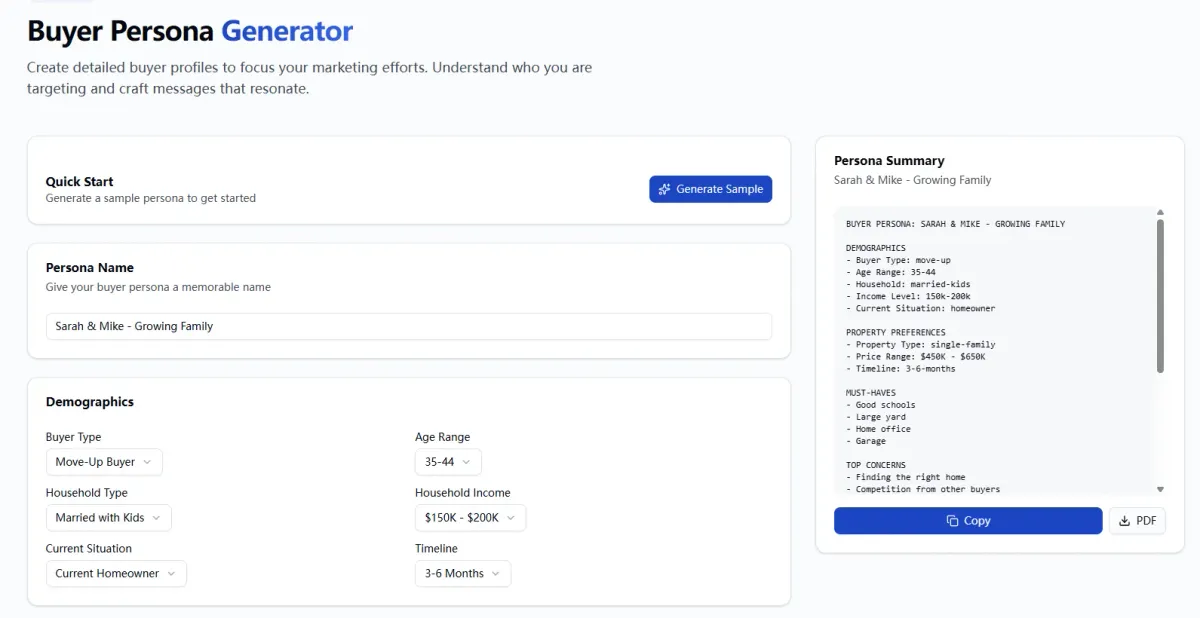
To solve this, Sarah turned to the EstatePass Buyer Persona Generator to scientifically define her target audience. Here is the exact workflow she used to transform her strategy.
Step 1: Initial Input (The "Rough Draft")
Sarah started by inputting basic demographic data she thought she knew.
Step 2: Refining with Psychographics
She used the tool to dig deeper, adding details about current market frustrations.
Step 3: Content Iteration
Armed with this persona, Sarah stopped sending generic "Just Listed" postcards. Instead, she used the persona insights to draft a specific email campaign addressing the "Fear of Homelessness" directly, offering a guide on lease-back agreements and bridge loans.
The Results: Quality Over Quantity
After 60 days of implementing the strategy based on the persona generated by EstatePass, Sarah saw a distinct shift in her business metrics. While results vary based on market conditions and execution, her outcomes included:

7-Step Checklist for Agents
If you want to replicate this segmentation strategy, copy this checklist before using a persona tool:

Best Practices vs. Common Mistakes
Best Practices (Do This) | Common Mistakes (Avoid This) |
|---|---|
Focus on Pain Points: Target the emotional reason for the move (e.g., "house is too small"), not just the budget. | Over-reliance on Demographics: Assuming all "Millennials" want the same thing is a fatal marketing error. |
Create Multiple Personas: Have one for "First-Time Buyers" and a different one for "Downsizing Seniors." | Set It and Forget It: Failing to update the persona when economic factors (like interest rates) change. |
Use Real Quotes: If a client asks a specific question, feed that into your persona profile. | Ignoring Fair Housing: Creating personas that exclude protected classes (see compliance note below). |
Align Channels: If your persona is a Gen Z buyer, focus on Instagram/TikTok, not direct mail. | Generic Inputs: Giving the tool vague information yields vague strategies. Be specific. |
FAQ: Buyer Personas in Real Estate
1. Why do I need a buyer persona generator?
A generator structures scattered data into a usable profile. It helps you uncover psychological motivators you might miss, allowing you to write marketing copy that feels personal to the reader.
2. Is the EstatePass Buyer Persona Generator free?
Yes, there are free tools available like the EstatePass Buyer Persona Generator that allow agents to quickly generate profiles without a subscription.
3. How many personas should a real estate agent have?
Most agents should start with 2 or 3 core personas (e.g., First-Time Buyer, Seller Upsizing, Relocation Client). Too many can dilute your marketing focus.
4. Can this improve my conversion rate?
Research suggests that personalized marketing can significantly increase engagement. By speaking directly to a lead's specific problem, you build trust faster, which is key to conversion.
5. How often should I update my personas?
In the U.S. market, it is recommended to review personas every 6 months or whenever there is a major economic shift (e.g., a Federal Reserve rate change).
6. Does this work for seller leads too?
Absolutely. You can create "Seller Personas" (e.g., "Downsizing Diane") to understand the specific fears sellers have about pricing, staging, and moving timelines.
7. Can I use AI to write content for these personas?
Yes. Once the generator creates the persona, you can feed that profile into AI writing tools to draft emails, blog posts, and ad copy that matches the persona's tone.
8. What is the difference between a target audience and a buyer persona?
A target audience is broad (e.g., "Homeowners in Florida"). A buyer persona is a semi-fictional character with a name, goals, and feelings (e.g., "Retiree Rick, worried about hurricane insurance costs").
Compliance Note & Disclaimer
Fair Housing Compliance:
When creating buyer personas, U.S. real estate agents must strictly adhere to the Fair Housing Act. You cannot create personas based on race, color, religion, sex, handicap, familial status, or national origin. Personas should be based on behaviors, interests, and financial goals (e.g., "golf enthusiasts" or "luxury condo seekers"), not protected demographics. Marketing must always be inclusive.
Disclaimer:
This article is for informational purposes only and does not constitute legal, financial, or professional advice. Real estate laws and market conditions vary by state and locality. Always consult with your broker or legal counsel regarding marketing compliance. The "Sarah" case study is a fictionalized example for illustrative purposes; individual results will vary.