
Securing the exact passing metrics for your state licensure test transforms your preparation from vague guesswork into a calculated strategy. If you are preparing for a PSI real estate exam or a Pearson VUE real estate exam, you must treat the official rules as the foundation of your study plan. Most candidates struggle not because they lack knowledge, but because they underestimate the specific exam format, timing constraints, and question styles outlined in provider bulletins.
Locate the Source of Truth: The Candidate Information Bulletin (CIB) is the only reliable document for verifying passing scores.
Understand Scoring nuances: Passing requirements often differ between the National and State portions of the exam.
Master the Clock: Timing rules vary significantly by jurisdiction and test provider.
Adapt to Complexity: Official outlines reveal whether questions demand simple recall or complex analysis.
Passing Score: Is it a percentage (e.g., 70%) or a scaled score?
Question Count: How many questions are scored versus pre-test (unscored) items?
Topic Weighting: Which domains (e.g., Contracts, Agency) carry the most points?
Provider Details: Specific contact info for PSI or Pearson VUE.
Aggregate Score: You need a total score across all questions (less common).
Sectional Cut Score: You must achieve a minimum score (e.g., 75%) on the National section AND a minimum on the State section.
Scaled Scoring: A statistical adjustment that accounts for slight differences in difficulty between exam versions.
Recall Questions: 30–45 seconds (Definition-based, instant answer).
Application Questions: 60–90 seconds (Requires applying a rule to a scenario).
Math/Analysis Questions: 2–3 minutes (Requires calculation or multi-step logic).
Recall: "Which deed provides the greatest protection?"
Application: "Given these closing figures, calculate the buyer's credit."
Analysis: "The seller refuses to disclose a latent defect. What is the broker's ethical obligation in this specific context?"
Identification: Two forms of valid, unexpired ID (one with a photo and signature).
Calculators: Verify if you can bring a handheld silent calculator or if you must use the digital one.
Prohibited Items: No scratch paper (whiteboards are usually provided), no food, no hoodies with pockets in some cases.
Download the Bulletin: Immediately secure the latest Candidate Information Bulletin for your specific state and provider.
Calculate Your Buffer: Determine exactly how many questions you can miss in each section to stay above the passing threshold.
Simulate Reality: Practice with strict time limits to ensure you can handle the pacing of a 3-4 hour exam.
Verify Logistics: Check the ID and calculator policies for your specific testing center to avoid exam-day disqualification.
Focus on Application: Shift your study time from rote memorization to analyzing scenario-based problems.
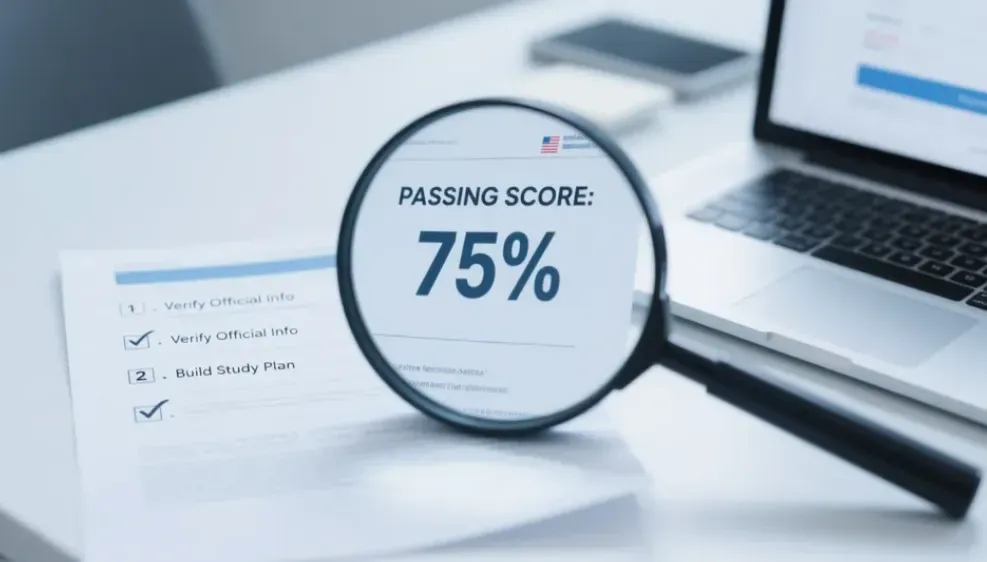
Decoding the Candidate Information Bulletin (CIB)
I cannot stress this enough: the Candidate Information Bulletin (CIB) or Candidate Handbook is the single most important document you will read. It is not just administrative paperwork; it is the blueprint for your licensure. While third-party study guides are helpful, they often contain outdated information regarding the PSI real estate exam or Pearson VUE real estate exam. State commissions frequently update their testing contracts and passing standards, and these changes appear in the CIB first.
The mechanism here is simple but often overlooked. State real estate commissions contract with testing vendors like PSI or Pearson VUE to administer exams. These vendors publish specific handbooks that detail the exact number of questions and the percentage required to pass. According to regulatory documents from states like Idaho and Florida, the passing score is not always a flat percentage; it can be a scaled score, typically ranging from 0 to 100, where a 70 or 75 represents the passing threshold. Relying on a blog post from two years ago could lead you to aim for the wrong target.
Key Data Points to Verify in the CIB:
Actionable Suggestion: Go directly to your state's real estate commission website today. Download the most recent Candidate Information Bulletin (usually a PDF). Do not rely on the testing provider's general site alone, as state-specific rules override general ones.

Analyzing the Passing Score Structure
Understanding how your score is calculated is critical for your mental game. In many jurisdictions, the exam is split into two distinct sections: National and State. Industry data indicates that you typically need to pass both sections independently. This means you could score a perfect 100% on the National portion but fail the State portion, resulting in a failed exam overall. However, knowing this structure allows you to compartmentalize your study adjustments.
The impact of this split is significant. If you fail one section, many states allow you to retake only the failed portion within a certain timeframe. This drastically reduces the pressure for a retake. Furthermore, the difficulty of questions often aligns with "cognitive levels." Research into exam blueprints shows that questions are categorized into Recall, Application, and Analysis. A passing score isn't just about memorizing definitions; it requires correctly answering scenario-based questions that test your ability to apply laws in real-world situations.
Common Scoring Configurations:
Actionable Suggestion: Calculate the "buffer" for each section. If the National section has 80 questions and the passing score is 70%, you can miss 24 questions. Write this number down. It changes your mindset from "I must be perfect" to "I have a margin for error."
Mastering Exam Timing and Pacing
Time management is the silent killer in standardized testing. The timing allocated for the exam varies wildly depending on the provider and the state. For instance, official handbooks for Florida candidates mention a 3.5-hour window, whereas other states might offer 4 hours for a combined exam. When you are under pressure, 3 hours feels much shorter. Poor pacing often forces candidates to rush through the complex math questions at the end, leading to avoidable errors.
You need to build a rhythm that mimics the actual test environment. If you spend three minutes on a difficult property valuation question, you are stealing time from three easier vocabulary questions. This is where realistic practice becomes non-negotiable. To truly understand if your pacing is on track, you should Simulate Exam Timing using tools that replicate the pressure of a ticking clock. This reveals whether you are prone to panic or if you linger too long on uncertain answers.
Recommended Pacing Breakdown:
Actionable Suggestion: During your practice sessions, set a timer for 50 questions and give yourself exactly 75 minutes. If you aren't finishing in time, skip the math questions during your first pass and return to them only after securing the easy points.

Adapting to Question Styles and Cognitive Levels
The question style on modern real estate exams has shifted away from simple memorization. Exam content outlines from major providers like Pearson VUE explicitly state that items are written at different cognitive levels. You will encounter "Recall" questions, which are straightforward, but the bulk of the passing points often come from "Application" and "Analysis" items. These questions present a hypothetical scenario between a buyer, seller, and agent, asking you to determine the best course of action.
This shift impacts your study strategy deeply. Flashcards are excellent for vocabulary, but they fail to prepare you for analysis questions. For example, a question might not ask "What is commingling?" but instead describe a broker depositing an earnest money check into a business operating account and ask you to identify the violation and its consequence. If you only memorized the definition, you might miss the nuance of the scenario.
Question Categories to Expect:
Actionable Suggestion: When reviewing practice questions, do not just check if you got it right or wrong. Explain why the other three distractors (wrong answers) are incorrect. This active engagement builds the analytical muscle needed for the exam.
Navigating Testing Center Rules
The environment at the testing center can throw you off balance if you are not prepared. Testing center rules for PSI and Pearson VUE are strictly enforced to maintain exam security. Official handbooks warn that you must arrive at least 30 minutes early. Arriving late often results in forfeiting your exam fee and your slot.
The security procedures are rigorous. You will likely be asked to empty your pockets, roll up your sleeves, and possibly undergo a metal detector scan. Personal items like phones, watches, and even specific types of calculators are often prohibited. Some centers provide a basic calculator on the computer screen, while others allow you to bring a non-programmable one. Knowing these details prevents last-minute panic.
Checklist for Exam Day:
Actionable Suggestion: Drive to the testing center a few days before your exam to verify the route and parking situation. eliminating logistical stress allows you to focus 100% on the content.
FAQ
Q: How do I find the exact passing score for my state?
A: You must download the Candidate Information Bulletin (CIB) from your state's real estate commission website or the testing provider's (PSI/Pearson VUE) official page. Third-party websites may have outdated data.
Q: Can I take the National and State exams on different days?
A: Generally, no. Most states require you to sit for both portions during the same appointment. However, if you pass one and fail the other, you can often retake just the failed section later.
Q: What happens if I run out of time during the exam?
A: Any unanswered questions are counted as incorrect. It is better to guess on the remaining questions in the final minute than to leave them blank, as there is typically no penalty for guessing.
Q: Are the questions the same for every candidate?
A: No. Testing providers use large banks of questions to generate unique exam forms. While the difficulty level is standardized via scaled scoring, your specific questions will differ from the person sitting next to you.
Q: How soon will I get my results?
A: In most PSI and Pearson VUE centers, you receive your official score report immediately upon leaving the testing room. The proctor will hand you a printed sheet indicating "Pass" or "Fail" (with a diagnostic breakdown if you failed).
Conclusion and Actionable Suggestions
Passing the real estate exam requires more than just reading a textbook; it demands a strategic approach based on verified official information. By aligning your study plan with the specific rules of your testing provider, you eliminate surprises and build confidence.