
Novation (Not Innovation): The "Trade-In" Trick That Helps You Nail Exam Questions
If a contract "switches to a new person," are you still on the hook?
This is where students lose easy points—because they memorize vocabulary, but miss the liability.
The exam word that screams "original party is released" is:
Novation.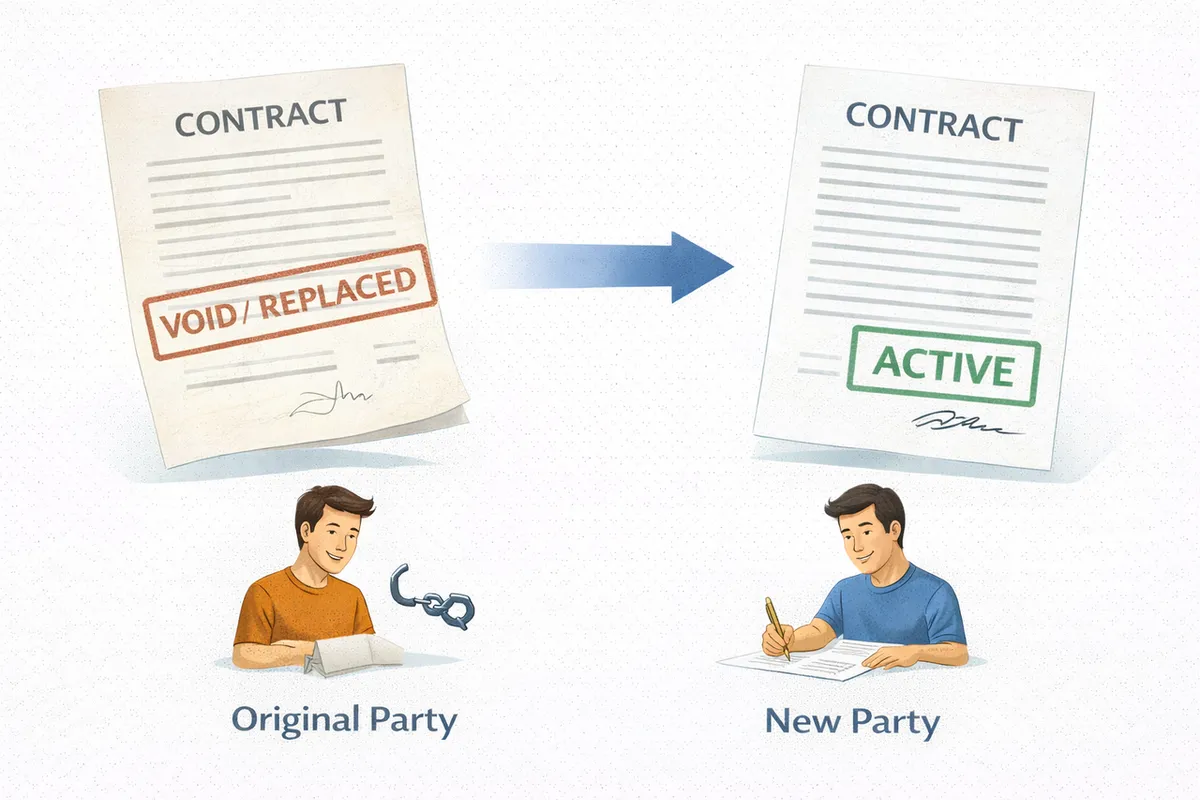
The 20-Second Definition (Exam Version)
Novation means: a new contract replaces (substitutes for) the old contract, and the original party is released from the obligation.Say it like this in your head:
New deal. Old deal dead. Old debtor free.
That's the exam payoff.
Don't Let the Spelling Trick You: Novation ≠ Innovation
Your brain sees novation and wants to read innovation.
Here's the fastest fix:
- INnovation = something new is created (innovation = "创新")
- NOvation = the old deal is NO more (old contract replaced)
If you remember nothing else, remember this:
Novation is not "new idea." It's "new contract replacing old contract."
The Memory Hook: "Trade-In" Mode (以旧换新)
Think of novation like upgrading your phone:
- You bring the old phone to the store.
- They take it back.
- You walk out with a new phone—and the old one no longer counts.
Now apply that to contracts:
- Old contract = traded in (extinguished)
- New contract = takes over (in force)
- Original obligor = fully released
That "release" part is the whole reason novation exists as a tested term.
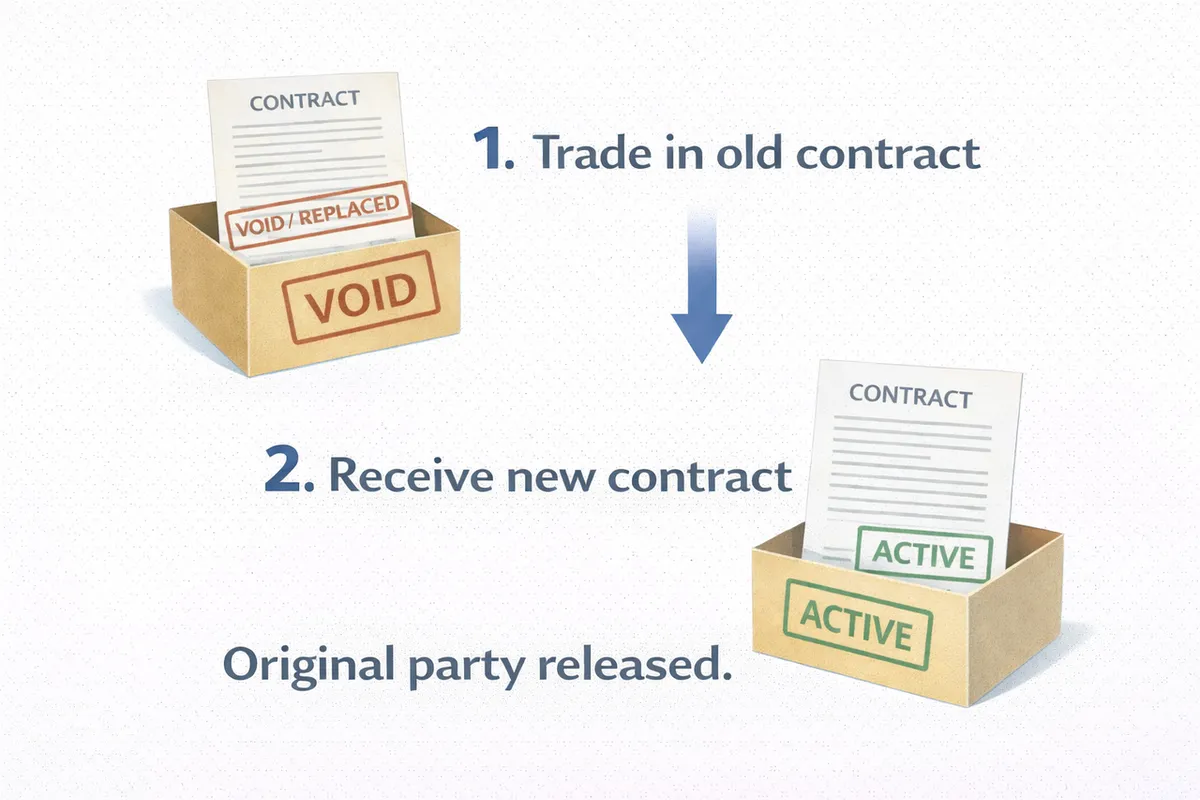
Visual Summary
| Step | What Happens |
| ------ | ------------- |
| 1. Trade in old contract | Old contract marked VOID/REPLACED |
| 2. Receive new contract | New contract becomes ACTIVE |
| 3. Original party released | No more liability for original party |
The One Question You Must Ask on Every Exam Problem
When the prompt talks about switching parties, ask yourself:
Does the original party remain liable—or are they released?
If the original party is released → Novation
This is the signature feature.
If the original party is still liable → not novation
It might be an assignment, delegation, or assumption situation.
This single question is your score multiplier.Novation vs. Assignment (The Most Common Confusion)
Here's the clean exam-friendly separation:
Assignment (转让权利)
- Usually means: someone transfers their rights/benefits under a contract
- But does not automatically release the original party from responsibility
Novation (合同更替)
- Means: the old contract is replaced with a new one
- Original party is released (this is the keyword)
So the exam giveaway is often a phrase like:
- "released from liability"
- "substituted"
- "replaced"
- "new contract"
- "all parties agree"
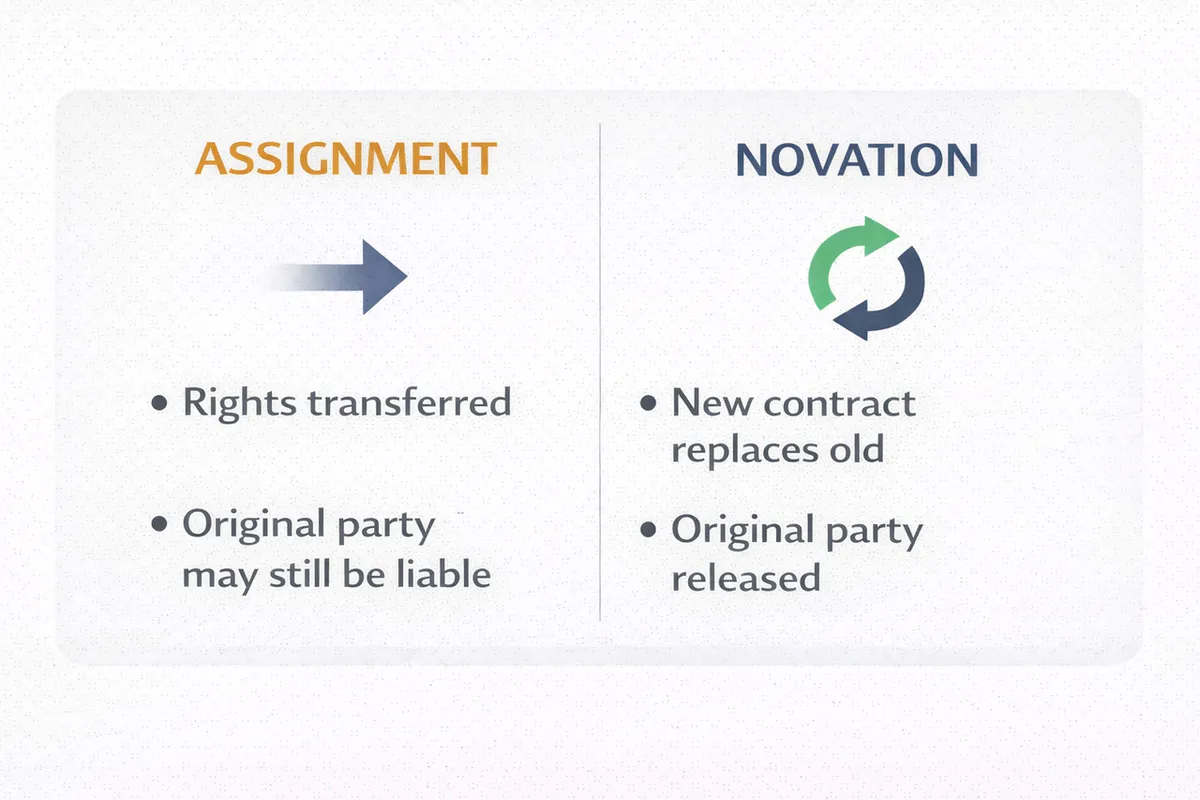
Quick Comparison
| Aspect | Assignment | Novation |
| -------- | ------------ | ---------- |
| What transfers | Rights transferred | New contract replaces old |
| Original party liability | May still be liable | Released from liability |
| Requires all parties consent | Usually no | Yes, all parties must agree |
Real Estate Example That Matches Exam Questions
You'll often see novation in leases.
Example:You signed a lease as Tenant A. Later, Tenant B takes over.
Now the key exam fork:
- If the landlord simply allows Tenant B to pay, but Tenant A is still responsible if Tenant B fails → not novation
- If the landlord signs a new agreement substituting Tenant B and explicitly releasing Tenant A → novation
In plain English:
Novation is when the landlord says, "You're out. They're in. Clean swap."
The Mini Checklist: How to Spot Novation Fast
When you're reading a question stem, scan for these three elements:
- Replacement: Is the old contract being replaced by a new one?
- Consent: Do all required parties agree to the replacement?
- Release: Is the original obligor clearly released from liability?
If you can check all three, you're in novation territory.
Novation Detector Checklist
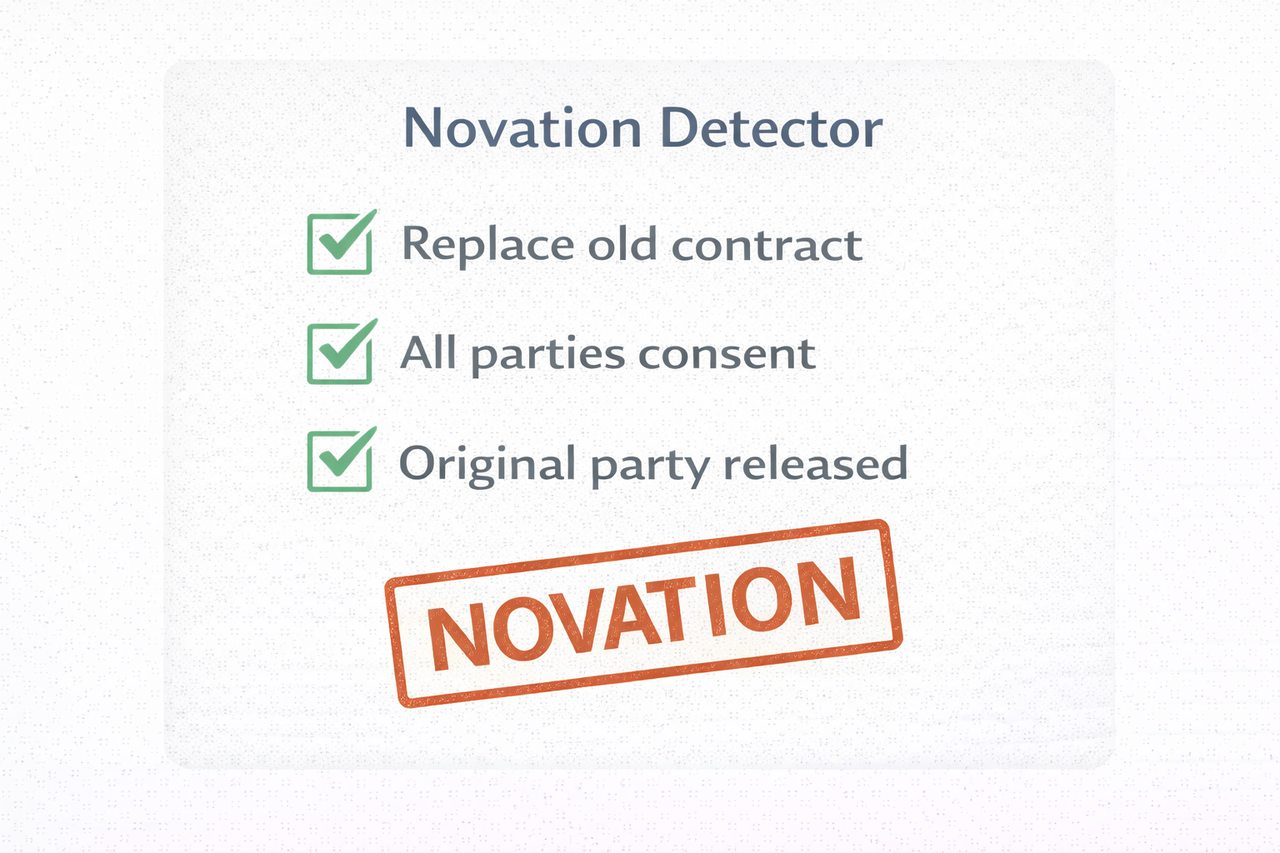
✓ All three checked = NOVATION
Your 10-Second Exam Cheat Sheet
If you see these phrases, answer NOVATION:- "New contract replaces old contract"
- "Substitute a new party" + "release the original party"
- "Original obligor discharged"
- "All parties consent to substitute"
Sample Exam Questions
Question 1
A landlord agrees to release Tenant A from a lease and accepts Tenant B as the new tenant under a new lease agreement. This is an example of:A. Assignment
B. Sublease
C. Novation ✓
D. Delegation
Explanation: The key is that Tenant A is released and a new agreement is created with Tenant B. This is the definition of novation.Question 2
Which of the following BEST describes novation?A. Transferring rights under a contract to a third party
B. Substituting a new contract for an old one, releasing the original party ✓
C. Adding additional terms to an existing contract
D. Assigning duties to another person
Explanation: Novation specifically involves replacing the old contract with a new one AND releasing the original party.Question 3
In a novation, all of the following are required EXCEPT:A. A valid existing contract
B. Agreement by all parties
C. A written document signed by a notary ✓
D. Release of the original party
Explanation: While novation requires agreement by all parties and release of the original party, it does not specifically require notarization.Final Thoughts
Novation isn't a fancy word. It's an exam shortcut for one idea:
"Trade in the old contract. Activate a new one. The original party is free."
Now test yourself (this is how you make it stick):
If the question says "A new party takes over the contract, and the original party is fully released from liability," what's the answer?If your brain immediately says novation, you've built the right reflex.
Key Terms to Remember
| Term | Definition |
| ------ | ------------ |
| Novation | Substituting a new contract for an old one, releasing the original party |
| Assignment | Transferring rights under a contract (original party may remain liable) |
| Delegation | Transferring duties under a contract |
| Assumption | New party agrees to take on obligations of existing contract |
Practice More
Ready to test your knowledge? Try our practice questions:
Start your free trial and access all practice questions →