
The "Shake-the-House" Test: What Counts as Chattel?
Here's a question that quietly ruins exam answers:
When you buy a house… are you buying the stuff inside it too?Sometimes yes. Sometimes no.
The word that separates "stuff you take" from "stuff that stays" is:
Chattel.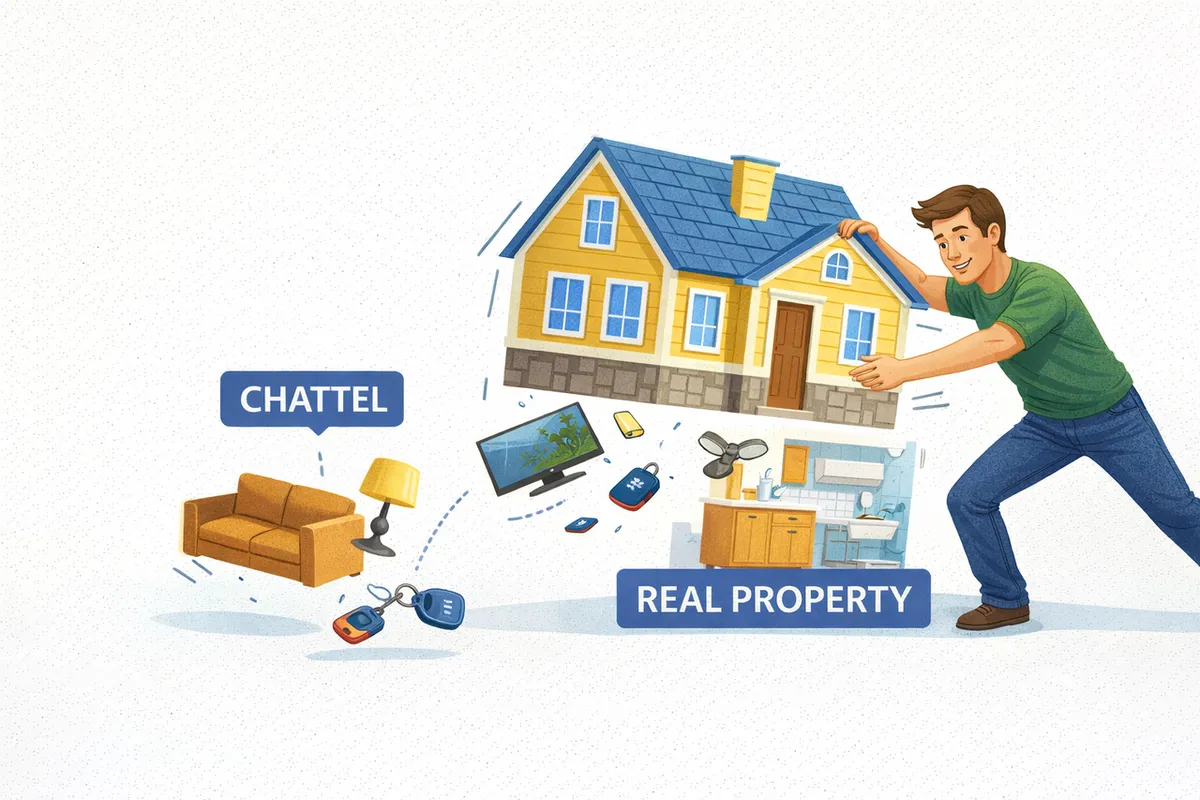
The 20-Second Definition
Chattel means movable personal property.Think: items that are not the land and not permanently part of the building.
In real estate language:
- Real Property = land + buildings + things attached in a permanent way
- Chattel = the movable "stuff" (personal property)
If you want the exam-level one-liner:
Chattel = personal property, not real property.
Why It Sounds Like "Cattle" (And Why That's Actually Helpful)
Yes—chattel sounds like cattle.
And historically, that's not a coincidence: in older societies, livestock (like cattle) was a major form of wealth—basically "property you can move."

So your brain can keep this shortcut:
Chattel = property you can walk away with.
(Like cattle… or a couch.)
The Memory Trick: Shake the House
Want a rule you'll remember under pressure?
Pick up the house. Turn it upside down. Shake it.- If it falls out → Chattel
- If it doesn't fall out (because it's part of the structure) → Real Property
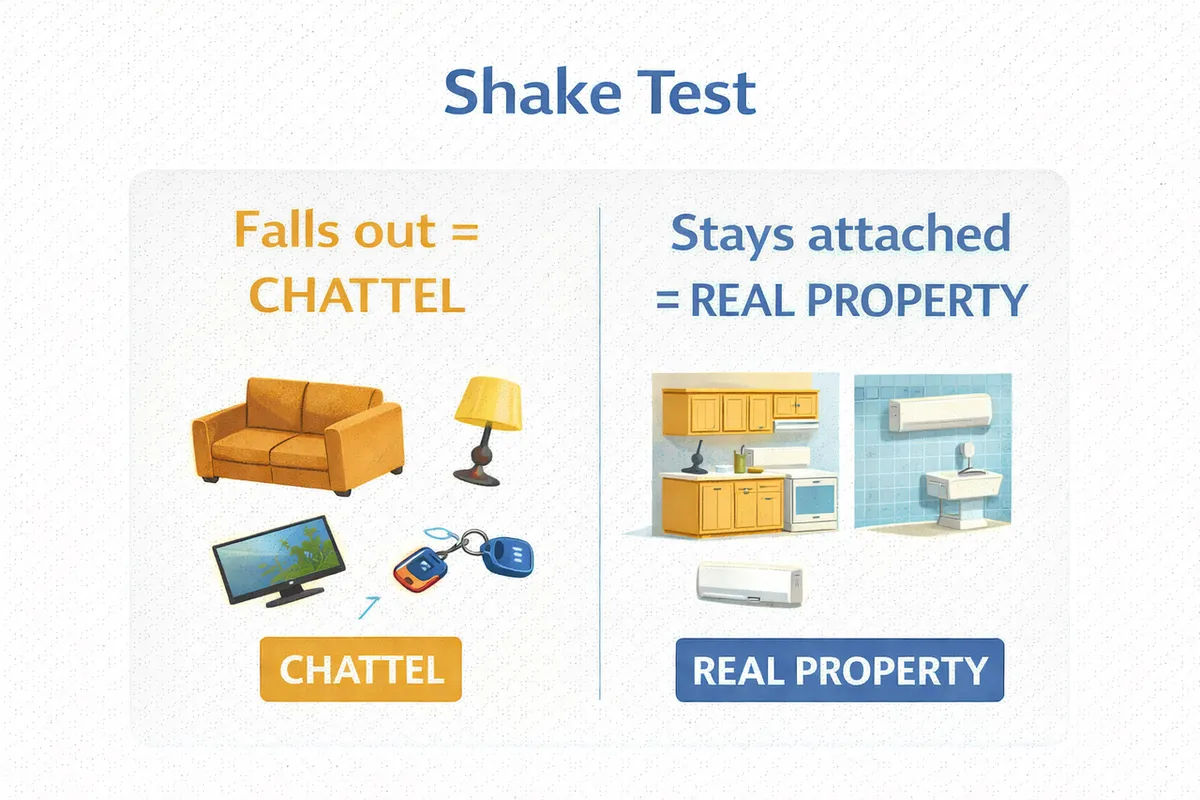
Examples that "fall out" (chattel):
- Sofa, dining table, beds
- TV (not wall-mounted as a built-in)
- Rugs, lamps
- Patio furniture
- Your car in the driveway
Examples that do NOT "fall out" (real property):
- Walls, roof, plumbing
- Built-in cabinets
- Built-in sink / toilet
- Central HVAC system
That's the mental model.
The #1 Exam Trap: Fixtures (The "In-Between" Category)
Here's where people get tricked:
Some things start as chattel but become real property when attached.That category is called a fixture.
A fixture is basically:
Something that was movable, but is now attached and intended to stay.

Classic examples that are often treated as fixtures (so they "stay"):
- Built-in light fixtures / chandeliers
- Curtain rods
- Wall-mounted shelving
- Built-in appliances (depending on how installed and local practice)
- Attached mailbox
So the real exam question isn't only "movable vs not."
It's usually:
Is it attached in a way that makes it part of the property?
The Practical Rule in Real Transactions
Here's the real-world version:
If there's any doubt, the contract should spell it out.Because buyers and sellers argue about the same items every year:
- "Does the refrigerator stay?"
- "What about the washer/dryer?"
- "Are those smart home devices included?"
- "That fancy wall-mounted TV… stays or goes?"
Your safest habit (and a sneaky exam hint) is:
Agreement controls.
If the purchase agreement lists it as included/excluded, that's the answer.
Your 10-Second Exam Cheat Sheet
If you see these keywords, your brain should snap to Chattel:- personal property
- movable
- not attached
- can be removed without damage
- attached
- built-in
- permanent improvement
- intended to remain
- part of the real estate
Look for: "What does the contract say?"
Sample Exam Questions
Question 1
A homeowner has a refrigerator in the kitchen that is not built-in. The refrigerator is considered:A. Real property
B. A fixture
C. Chattel (personal property) ✓
D. An appurtenance
Explanation: A freestanding refrigerator is movable personal property (chattel), not attached to the real property.Question 2
Which of the following is generally considered a fixture?A. A throw rug
B. A freestanding bookshelf
C. A ceiling fan that is wired into the electrical system ✓
D. A potted plant on the patio
Explanation: A ceiling fan wired into the electrical system is attached and intended to remain, making it a fixture.Question 3
The primary test for determining whether an item is a fixture or chattel is:A. The cost of the item
B. The size of the item
C. The method of attachment and intent ✓
D. The age of the item
Explanation: Courts look at how the item is attached and whether it was intended to be permanent.Key Terms to Remember
| Term | Definition |
| ------ | ------------ |
| Chattel | Movable personal property (not real property) |
| Real Property | Land and everything permanently attached to it |
| Fixture | Item that was chattel but became real property by attachment |
| Personal Property | Another term for chattel; movable items |
| Appurtenance | Rights that go with the land (easements, etc.) |
Final Thoughts
If you remember only one thing, remember this:
Shake the house. What falls out is chattel. What stays is real property.
Practice More
Ready to test your knowledge? Try our practice questions:
Start your free trial and access all practice questions →