
Can Someone LEGALLY Steal Your House? "Adverse Possession" Explained
Imagine owning a piece of land. You pay the taxes. Your name is on the deed.
But you are busy, lazy, or just forgetful. You haven't visited the property in 20 years.
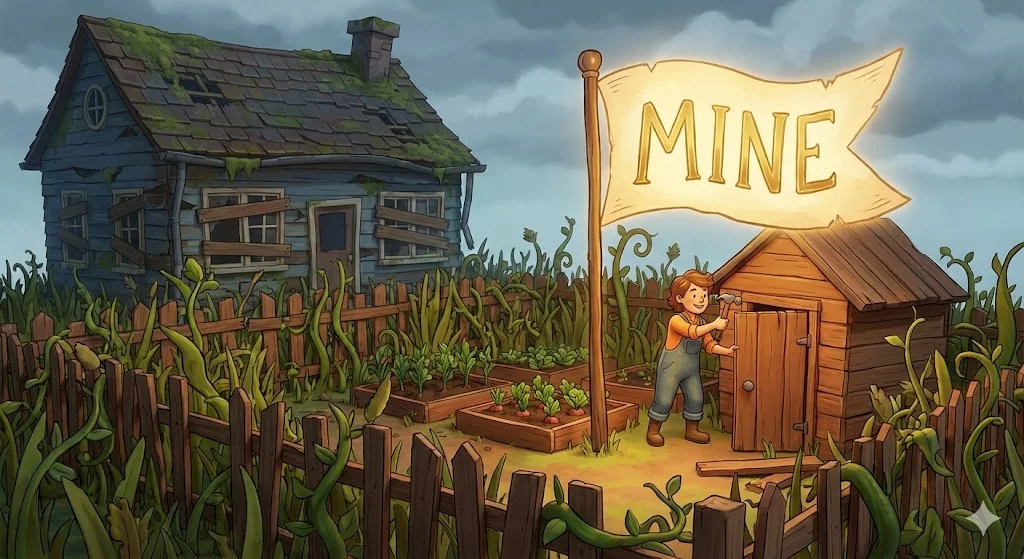
One day, you drive by and see a stranger living there. They built a cabin. They planted a garden. They put up a "Private Property" sign.
You call the police to kick them out for trespassing.
But the police tell you something shocking: "Sorry, this might be their land now."
Welcome to the wild world of Adverse Possession.
It sounds like legalized theft. In the real estate exam, it's one of the most confusing—and most tested—concepts.
Today, we're going to master Adverse Possession by learning the "Squatter's Secret Formula."
The 30-Second Definition
Adverse Possession (sometimes called "squatter's rights") is a legal principle where a person who does not own a piece of property can become the legal owner by openly using it for a long period of time.It sounds crazy, right? Why would the law allow this?
The law hates wasted land. It prefers an active user over a lazy owner.But it's not easy to do. You can't just sneak into someone's basement and claim the house.
To successfully claim Adverse Possession, a squatter must follow a very strict, 5-step recipe.
The 5-Step "Squatter's Recipe" (OCEAN)
If you want to pass your real estate exam, you need to memorize the acronym O.C.E.A.N.
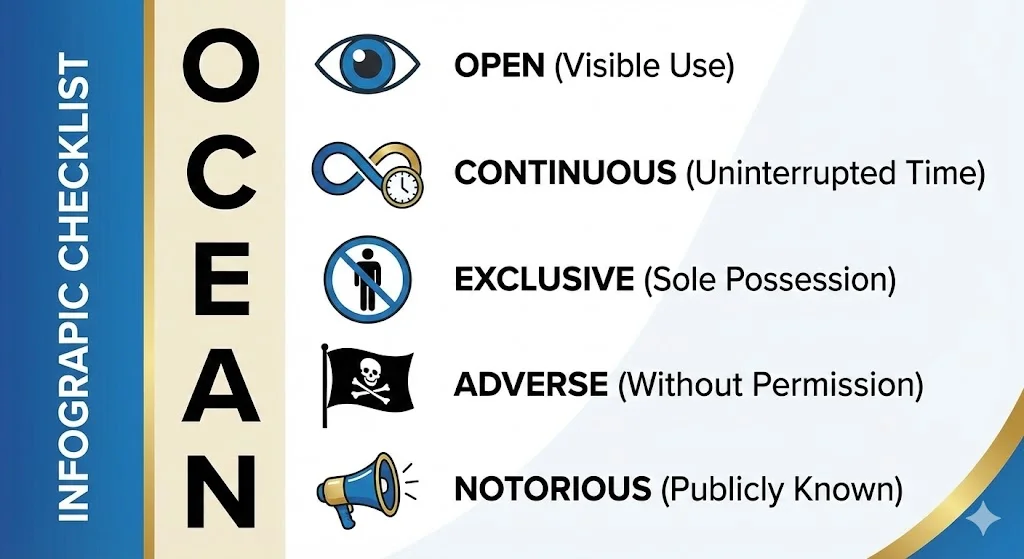
Here is the breakdown of the recipe:
- O - Open: You can't hide. You must use the land perfectly visibly, like a real owner would. (e.g., Building a fence, mowing the lawn).
- C - Continuous: You cannot take a break. You must use the land without interruption for the entire statutory period (which varies by state, usually 5 to 20 years).
- E - Exclusive: You can't share. The use must be yours alone, not shared with the public or the true owner.
- A - Adverse (or Hostile): This doesn't mean you are angry. It means you are using the land without the owner's permission. If the owner gives you permission, it's not adverse possession; it's just a license.
- N - Notorious: Your use must be so obvious that the true owner should have known about it if they were paying attention.
The Exam Trap: Trespass vs. Adverse Possession
This is where students lose points.
- Trespassing is the act of being on someone's land illegally. It's a crime.
- Adverse Possession is what happens when trespassing continues openly and continuously for years, and the owner does nothing to stop it.
Your Cheat Sheet for the Exam
If you see a question about "squatter's rights" on your exam, look for these keywords:
- O.C.E.A.N. (Always write this down on your scratch paper!)
- Statutory Period (The required number of years, e.g., "for 20 years").
- Without Permission (This is the key ingredient for "Adverse/Hostile").
Final Thoughts
Adverse Possession is a perfect example of the real estate phrase: "Use it or lose it." It's a dramatic legal concept, but it's rare in the modern world.
Do you feel like you understand the "Squatter's Recipe" now?
One question for you (and it's a great self-test):
If a property owner gives someone permission to use their land, can that person later claim adverse possession?
The answer is no—because one of the OCEAN requirements is that possession must be Adverse (without permission). Permission destroys the adverse possession claim.
That's the key to getting adverse possession questions right on your exam.