
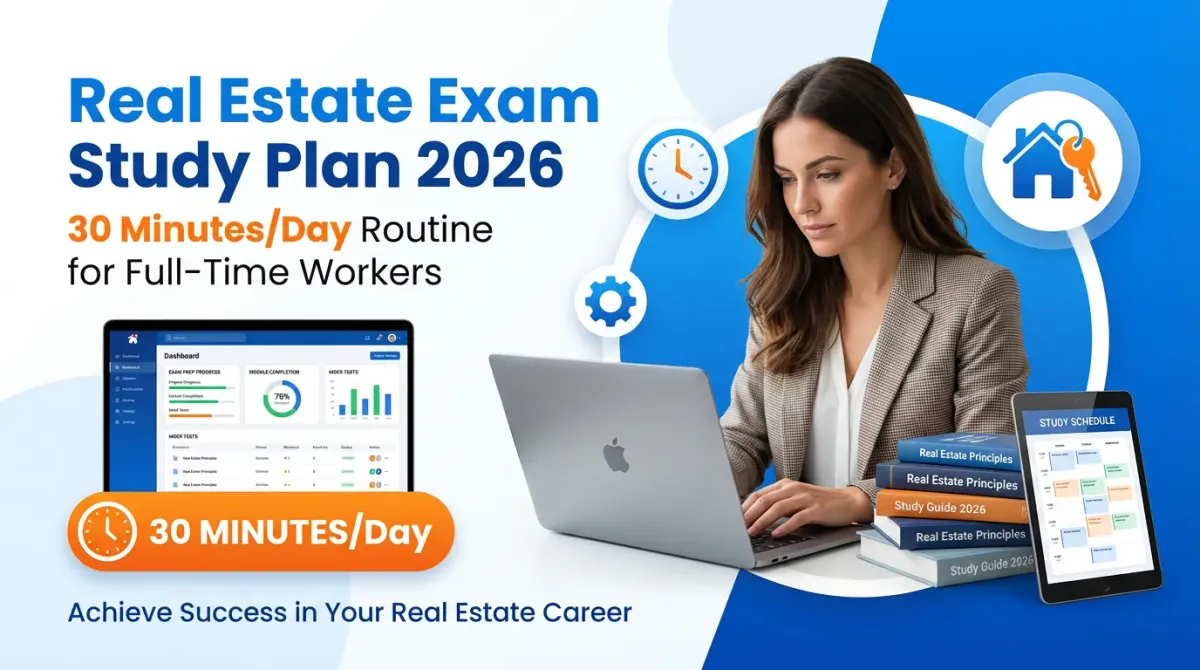
Passing the real estate licensing exam while working a full-time job does not require sleepless nights, but it does demand a shift from passive reading to active, high-intensity drills. If you are a busy professional balancing a 40-hour work week with family obligations, the traditional advice of reading dense textbooks for hours is a recipe for failure. This guide outlines a hyper-efficient strategy built on microlearning, daily practice questions, and strategic weekend mock exams to get you licensed in weeks, not months.
Abandon Passive Reading: Replace textbook skimming with active recall through practice questions.
The 30-Minute Drill: A strict daily routine focused on high-yield topics.
Weekend Simulations: Using Saturday mornings for full-length timed tests to build stamina.
Digital Tools: Utilizing mobile-friendly platforms for studying during commutes.
Minutes 0-5 (Warm-up): Review the 5 questions you got wrong yesterday. Understand why the correct answer is correct.
Minutes 5-25 (Core Workout): Complete 20-30 new practice questions on a specific topic (e.g., Contracts or Valuation). Do not guess; if you don't know, mark it.
Minutes 25-30 (Cool-down): Briefly read the explanations for any questions you missed in this session.
Stamina Building: It trains your brain to maintain focus for hundreds of questions.
Gap Analysis: It reveals exactly which categories (e.g., Federal Laws vs. Math) are dragging your score down.
Block Your Time: Schedule a recurring 30-minute appointment with yourself every morning for active drills.
Audit Your Weekends: Dedicate Saturday mornings to a full-length, timed mock exam to build mental endurance.
Use Tech: Utilize mobile apps to turn commute time into passive study sessions.
Trust the Data: Focus 80% of your time on the 20% of topics where your scores are lowest.
Start Now: Do not wait for the "perfect time." Take a baseline assessment today to see where you stand.
The Failure of Traditional Study Methods for Busy Professionals
Most aspiring agents fail their first attempt because they try to replicate a college student's schedule while living a working adult's life. Sitting down for three hours after a long workday to read about property law is ineffective; your brain is too tired to retain the information. Industry data suggests that retention rates for passive reading drop significantly after just 20 minutes of fatigue.
For full-time workers, the only viable path is microlearning. This approach breaks complex real estate concepts—like zoning laws or mortgage financing—into bite-sized chunks that can be digested in short bursts. Instead of "studying Chapter 4," your goal becomes "mastering 10 questions on agency relationships." This shift reduces psychological friction and prevents burnout.
Actionable Advice: Stop trying to read the textbook cover-to-cover. Use it only as a reference to look up concepts you missed in your practice questions.

Structuring the 30-Minute Daily Drill
You need to carve out exactly 30 minutes a day. I recommend doing this early in the morning before your email inbox floods, or during your lunch break. The key here is intensity, not duration. A focused 30-minute session is far more valuable than two hours of distracted page-turning.
Here is the breakdown of an effective 30-minute session:
This routine leverages the "testing effect," a psychological phenomenon where your brain prioritizes information it is forced to retrieve. By constantly testing yourself, you build a "habit building" loop that reinforces memory far better than highlighting text.
Actionable Advice: Set a recurring alarm on your phone for your study block. Treat it as a non-negotiable meeting with your future career.
The Weekend Protocol: Mock Exams and Stamina
While short daily bursts are excellent for learning content, they do not prepare you for the mental marathon of exam day. The state licensing exam is a timed test that often lasts 2-4 hours. You cannot simulate this pressure in 30-minute increments.
Every weekend, preferably on Saturday morning when your mind is fresh, you must take a full-length weekend mock exam. This serves two purposes:
According to data from successful candidates, those who pass on the first try typically complete between 1,000 and 2,000 practice questions total before their exam date. The weekend mock exam is where you rack up this volume.
Actionable Advice: Simulate real conditions. Put your phone in another room, turn off the music, and time yourself strictly. If you can score 80% consistently at home, you are ready for the real center.
Leveraging Technology for "Dead Time"
The "30 minutes a day" plan covers your active study time, but you should also utilize "dead time"—commuting, washing dishes, or waiting in line. This is where audio lessons and mobile apps come into play. Modern EstatePass tools allow you to listen to podcast-style lessons or run through flashcards on your phone.
I have seen many candidates add an extra 3-4 hours of study time per week just by listening to real estate concepts while driving. This passive input supports your active morning drills. For example, if you drilled "Fiduciary Duties" in the morning, listening to a case study on it during your drive home solidifies the concept.
Market analysis indicates that users of modern, AI-driven platforms achieve pass rates as high as 94%, largely because these tools adapt to your weak points automatically. Instead of wasting time on what you already know, the algorithm feeds you the questions you struggle with.
Actionable Advice: Download a exam prep app that supports offline mode so you can study even without a signal.
Tracking Metrics to optimize the Plan
You cannot improve what you do not measure. A common mistake is studying "randomly." You need to know your accuracy rate by category. If you are scoring 90% in Property Ownership but only 45% in Real Estate Math, spending your 30-minute block on Ownership is a waste of time.
Use a platform that provides detailed analytics. Look for a "Topic Review" feature that visualizes your proficiency. Your study plan for busy people must be agile; if the data shows you are weak in math, devote the next three daily sessions exclusively to math problems.
For those looking to assess their current baseline without commitment, you can Start Free Practice to see exactly where your knowledge gaps lie before building your full schedule.
Actionable Advice: Conduct a "Weekly Audit" every Sunday night. Review your mock exam scores and decide which two topics will be your focus for the upcoming week's daily drills.

FAQ
Can I really pass with just 30 minutes a day?
Yes, if you start early enough. If you have 2-3 months before your exam, 30 minutes of focused active recall is sufficient. If your exam is next week, you will need to increase the volume.
What should I do if I keep failing the mock exams?
Stop taking full exams for a few days. Go back to "Topic Review" mode. Isolate the specific category causing you to fail (usually Math or Contracts) and drill only that topic until your accuracy improves.
Is it better to study in the morning or at night?
For most working adults, mornings are better. Decision fatigue sets in after a full workday, making retention difficult at night. Getting it done first thing ensures consistency.
How many practice questions should I do total?
Aim for at least 1,500 questions total. This volume ensures you have seen almost every variation of how a question can be phrased.
Conclusion and Actionable Suggestions
Passing the real estate exam while working full-time is a challenge of discipline, not intelligence. By condensing your study time into high-intensity, data-driven sessions, you avoid the burnout that plagues many candidates. The goal is to make studying a natural part of your day, not a burden.