
Battle Royale vs. Inheritance Mode: Joint Tenancy vs. Tenancy in Common
Here's the fastest way to stop missing points on this topic:
Forget the fancy words. Focus on one question:When one owner dies… where does their share go?
That's the whole game.
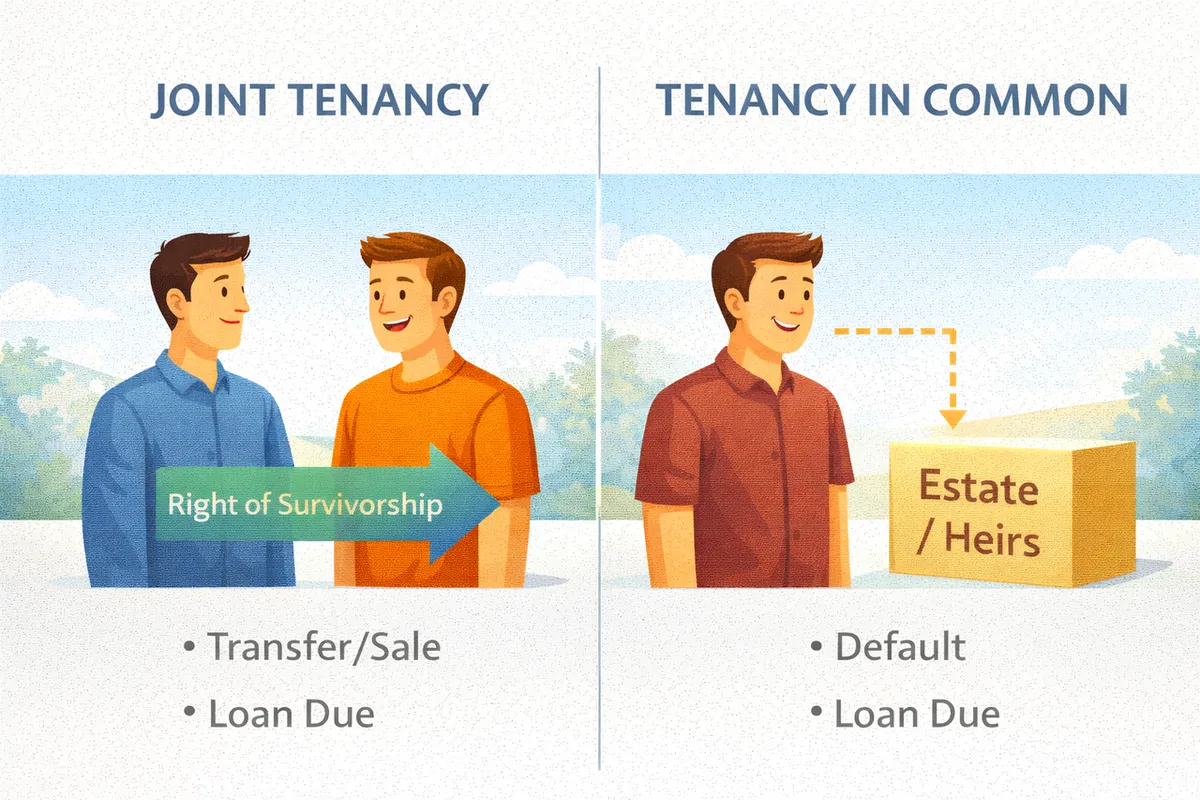
The 30-Second Definition
Joint Tenancy (JT)
Co-owners hold title with a right of survivorship: when one owner dies, their share automatically transfers to the surviving owner(s).
Tenancy in Common (TIC)
Co-owners each own a share, but there is no right of survivorship. When one owner dies, their share goes to their estate/heirs (not automatically to the other co-owners).
If you want the one-line exam summary:
Survivorship = Joint Tenancy. Heirs = Tenancy in Common.
The Memory Hook: Two "Game Modes"
Let's make this stick with an image your brain won't forget.
Joint Tenancy = "Battle Royale mode"
Everyone starts together.
The last surviving owner ends up with 100%.Tenancy in Common = "Inheritance mode"
You own a share.
If you die, your share can be left to your kids/heirs (through your estate).
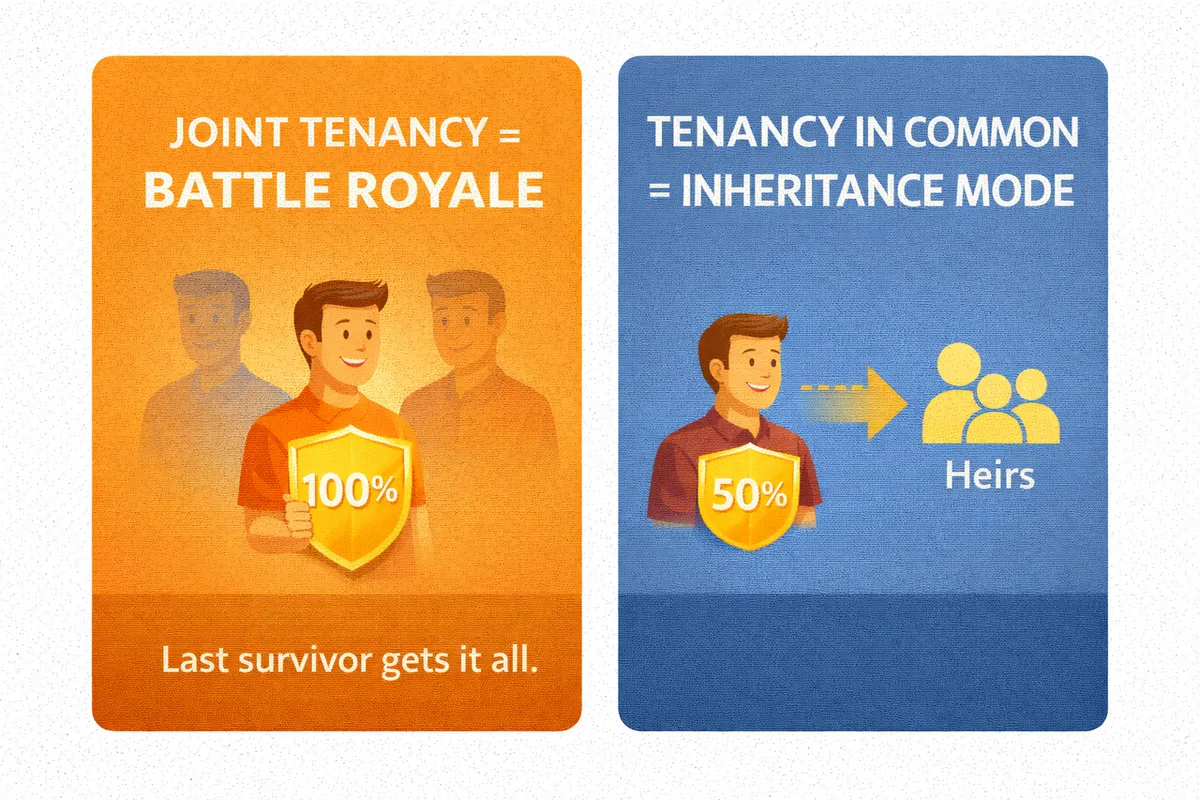
That's the entire difference, in one picture.
What Happens When Someone Dies (This Is What Exams Test)
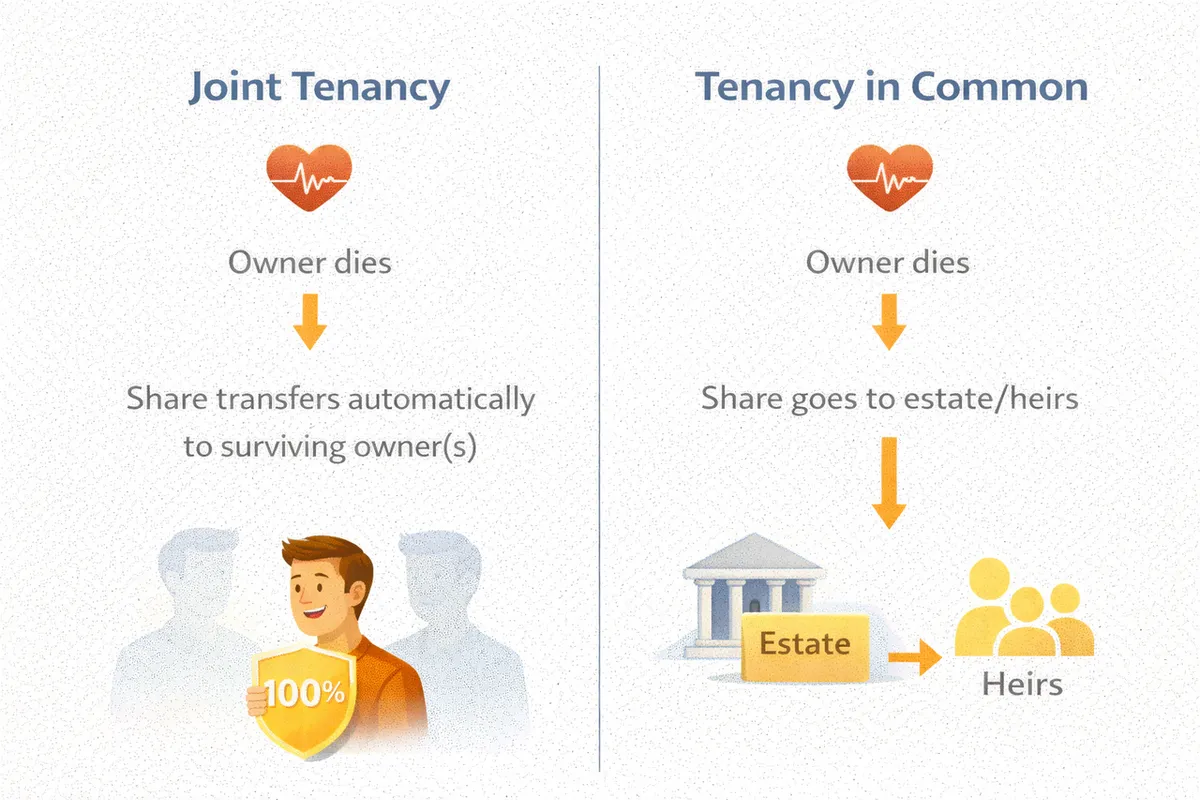
If two people own as Joint Tenants…
Owner A dies.
Owner A's share disappears and automatically belongs to Owner B (by operation of law).Translation:
- It usually does not go through probate for that share
- A will typically can't redirect it
If two people own as Tenants in Common…
Owner A dies.
Owner A's share goes to Owner A's estate/heirs (who may become new co-owners with Owner B).Translation:
- Your share is inheritable
Quick Reality Check: Ownership Shares
This is another common confusion point.
Joint Tenancy (typical exam framing)
Often described as equal interests among joint tenants, plus survivorship.
Tenancy in Common
Owners can have unequal shares (e.g., 60/40), and each owner can transfer their share.
If you see "unequal shares", your exam brain should whisper: TIC.The "Four Unities" Clue (When the Question Gets Technical)
Some exams go one level deeper and test how joint tenancy is formed.
Joint tenancy traditionally requires the four unities (often taught as PITT: Possession, Interest, Time, Title). Tenancy in common generally requires only unity of possession (each has a right to possess the whole), and lacks survivorship.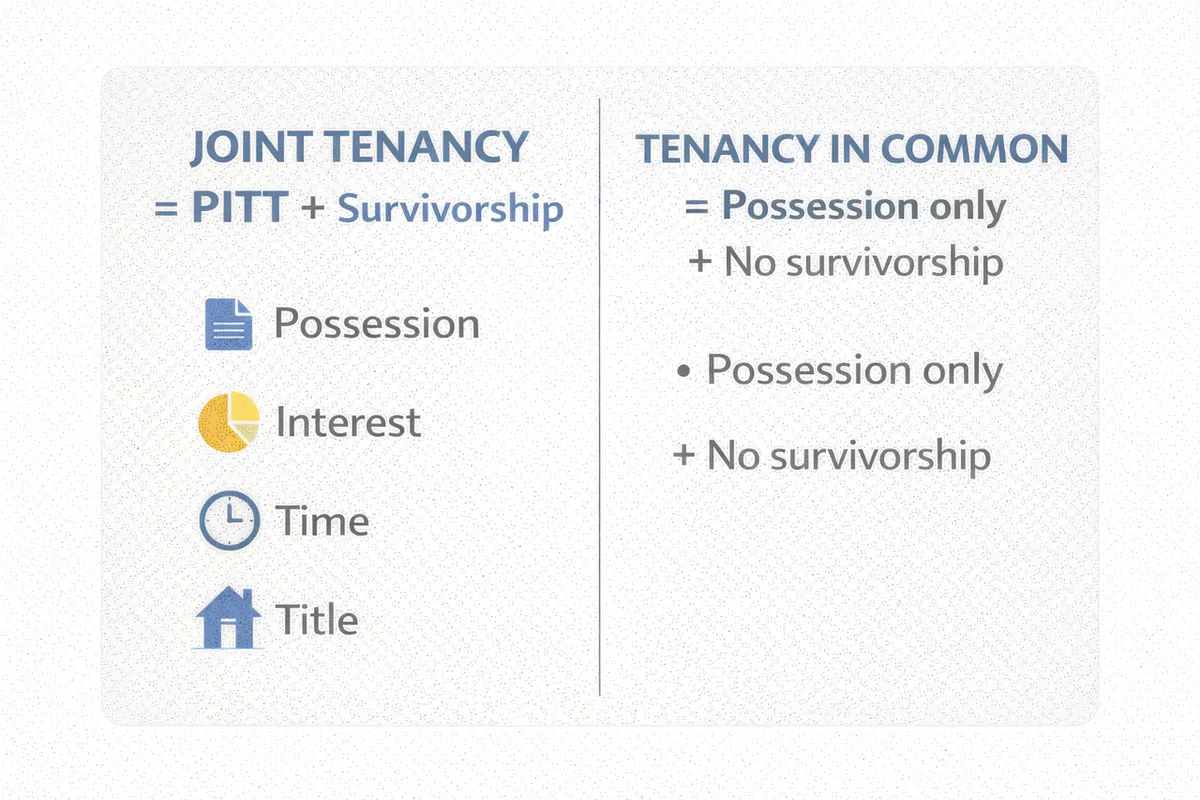
The #1 Exam Trap (Read This Twice)
Trap: "If I'm a joint tenant, I can leave my share to my kids in my will." Usually, no.With a right of survivorship, the share transfers automatically to the surviving owner(s), even if the will says otherwise.
So your mental rule should be:
- Joint Tenancy: your "will" does not control that share (survivorship does)
- Tenancy in Common: your will/estate plan can control your share
Your 10-Second Exam Cheat Sheet
If you see these words, pick Joint Tenancy:- Right of survivorship
- Automatically transfers to surviving owner(s)
- PITT / four unities
- Equal interests
- Heirs / estate
- No survivorship
- Unequal shares
- Can be willed to others
Sample Exam Questions
Question 1
Two people own property as joint tenants. One owner dies. What happens to the deceased owner's interest?A. It passes to the deceased's heirs through probate
B. It automatically transfers to the surviving owner ✓
C. It becomes property of the state
D. It must be sold to pay estate taxes
Explanation: Joint tenancy includes the right of survivorship, so the share automatically goes to the surviving owner.Question 2
Which form of co-ownership allows owners to have unequal shares?A. Joint tenancy
B. Tenancy by the entirety
C. Tenancy in common ✓
D. Community property
Explanation: Tenancy in common allows unequal ownership shares (e.g., 60/40).Question 3
Joint tenancy requires four unities. What are they?A. Possession, Interest, Time, Title (PITT) ✓
B. Property, Income, Tax, Transfer
C. Purchase, Intent, Term, Trust
D. Possession, Inheritance, Transfer, Tax
Explanation: PITT stands for Possession, Interest, Time, and Title - all required for joint tenancy.Key Terms to Remember
| Term | Definition |
| ------ | ------------ |
| Joint Tenancy | Co-ownership with right of survivorship |
| Tenancy in Common | Co-ownership without survivorship; share goes to heirs |
| Right of Survivorship | Automatic transfer to surviving owner(s) upon death |
| Four Unities (PITT) | Possession, Interest, Time, Title - required for JT |
| Severance | Breaking a joint tenancy (e.g., by selling your share) |
Final Thoughts
If your brain wants one sentence to remember forever, use this:
Joint Tenancy is "last survivor gets it all." Tenancy in Common is "my share can go to my heirs."
Practice More
Ready to test your knowledge? Try our practice questions:
Start your free trial and access all practice questions →